



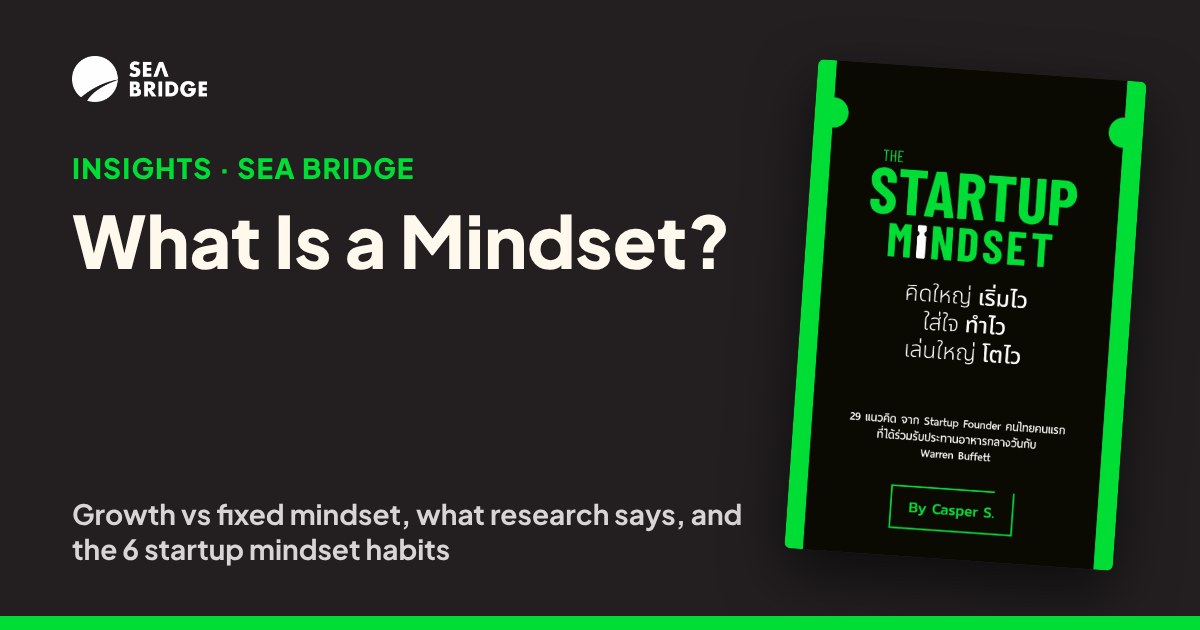
In short: A mindset is the set of beliefs that shapes how you read yourself and the situations you face, and what you choose to do next. The best-known version is Stanford psychologist Carol Dweck's split between a growth mindset and a fixed mindset.1 A startup mindset takes the belief that you can grow and turns it into six founder habits, as described in the book The Startup Mindset.
Picture someone working late, hunched over a phone with no desk in sight. A doctor sees back pain coming. A designer sees bad ergonomics. An entrepreneur might see someone building something.
Same picture, three readings, and none of them is wrong. Each person is looking through their own frame. That frame is a mindset.
What is a mindset?
A mindset is the set of beliefs and assumptions you use to make sense of what happens to you. When you hit an obstacle, do you see a dead end or a problem to solve? When someone critiques your work, do you feel attacked, or do you get information you can use?
Dweck argues that a mindset is not fixed at birth. It can shift when you practice new ways of seeing and acting, again and again.1
Types of mindset: growth vs. fixed
The terms growth mindset and fixed mindset come from decades of research by Carol Dweck, brought together in her book Mindset: The New Psychology of Success (2006).1
What is a fixed mindset?
A fixed mindset is the belief that intelligence and talent are set: you have a certain amount, and that is that.2 People who think this way tend to worry about looking less capable, so they avoid hard tasks, steer clear of problems and hide their mistakes.2
What is a growth mindset?
A growth mindset is the belief that intelligence and new skills can be developed through effort.2 People who think this way tend to value learning and improving over looking smart.2
Growth vs. fixed mindset: the key differences
- Facing a hard task: Fixed avoids it to avoid looking less capable · Growth tries it as a chance to learn
- Making a mistake: Fixed hides it or blames something else · Growth owns it and looks for the fix
- Needing a lot of effort: Fixed reads it as a lack of talent · Growth reads it as the way to get better
- Getting criticism: Fixed feels attacked · Growth treats it as useful information
This comparison summarizes Dweck's ideas1, 2 for illustration. It is not a measurement tool.
What the research says: how much does a growth mindset help?
A growth mindset is a useful idea, but it is worth knowing the evidence before expecting that changing a belief will change your results.
- Sisk and colleagues (2018) ran two meta-analyses. The first pooled 129 studies (365,915 participants) and found a weak overall link between mindset and academic achievement. The second pooled 29 studies (57,155 participants) and found that growth mindset programs also had small overall effects, with possible benefits for students from low-income families or students at academic risk.3
- In 2023, Macnamara and Burgoyne ran a systematic review and concluded that the positive results reported in many studies are likely explained by weak study design, reporting flaws and bias.4
- Another group (Tipton and colleagues, 2023) responded that effects may vary a great deal across students and settings, and that this variation deserves closer analysis than a simple "works or doesn't work" verdict.5
The takeaway: believing you can grow is a good starting point, but not enough on its own. Real results come from what you do, repeatedly, every day. That leads to the next question.
What is a startup mindset?
A startup mindset (close to what researchers call an entrepreneurial mindset) is the way founders think and act: they see a problem, ask what they can do about it, and start testing before anything is certain.
Researchers themselves have not settled on one definition. A review by Daspit, Fox and Findley (2023), covering 61 studies, found very little agreement on what an entrepreneurial mindset actually is.6 Darsel Keane and colleagues at the University of Auckland reviewed 471 documents and grouped the definitions in use into four kinds: cognition, ability, personality and disposition.7
The Startup Mindset by Casper S. takes a practical definition: six habits founders use to turn an idea into a company that survives and grows. Each habit comes with lessons and true stories.
- Dream It (chapters 1–3): Dream big enough to stay in the game until the chance shows up.
- Do It (chapters 4–8): Make the first move: test fast, learn from real people, ship the simple fix.
- Own It (chapters 9–14): As you grow, guard your attention and the details others miss.
- Crack It (chapters 15–19): Use speed as your edge: show before you finish, and write to think clearly.
- Play It (chapters 20–25): Stand out with an edge, a culture and a story that are truly yours.
- Nail It (chapters 26–29): Scale with systems that take the heat and people who run with you.
Growth mindset vs. startup mindset
- What it is about: Growth mindset is a belief about your own abilities · Startup mindset is a set of habits for building something new
- The core question: Growth asks "Can I get better?" · Startup asks "What do I do next, with what I have now?"
- Where it comes from: Growth mindset comes from Dweck's psychology research1 · The startup mindset comes from founders' experience in The Startup Mindset
- Where it shows: Growth shows in how you handle difficulty and mistakes · Startup shows in what you repeat every day, such as talking to customers, shipping early and giving first
The two do not compete; they work together. A growth mindset gives you the belief that you can improve. A startup mindset tells you what to do with that belief.
How to build a startup mindset: 6 things to try today
- Dream It: Write down one goal bigger than what you can do today, then ask who it would help.
- Do It: Take your idea to 3 real customers this week, before you invest more.
- Own It: Look back at last week's calendar and find the hours that went to things that did not really matter.
- Crack It: Pick one piece of work you are still polishing and show it to someone who will use it, before it is finished.
- Play It: Try to say how you are different in one sentence. If you can't yet, that is your homework.
- Nail It: Find one person a step ahead of you, and one person you can help.
Where is your mindset today?
Take the free Startup Mindset Test. It takes about 4 minutes: rate 24 statements and get a score from −100 to +100, a score for each of the six habits, and the part of the book to read first. It is a reflection tool, not a validated psychometric test.
Frequently asked questions
What is a mindset?
The set of beliefs that shapes how you read yourself and the situations you face, and what you choose to do next.
What is a growth mindset?
The belief that intelligence and skills can be developed through effort. The idea comes from Carol Dweck, a psychologist at Stanford University.1, 2
What is a fixed mindset?
The belief that intelligence and talent are set, which tends to make people avoid hard tasks and fear mistakes.2
Can you change your mindset?
Yes, but not by reading or hearing about it once. Research finds that growth mindset programs have small overall effects.3, 4 What helps more is practicing new ways of acting until they become habits.
How is a startup mindset different from a growth mindset?
A growth mindset is the belief that you can improve. A startup mindset is a set of founder habits, such as starting before you feel ready, showing your work early and growing with others.
Read next
- Startup Mindset Test
- The Startup Mindset, the book
- The Global Entrepreneurial Mindset
- Mindset คืออะไร (Thai version)
References
- Dweck, C. S. (2006). Mindset: The new psychology of success. Random House (paperback, Ballantine, 2007). https://www.penguinrandomhouse.com/books/44330/mindset-by-carol-s-dweck-phd/9780345472328/
- Stanford Clayman Institute for Gender Research. (2015, January 12). Understanding mindset for success. https://gender.stanford.edu/news/understanding-mindset-success (accessed November 2026)
- Sisk, V. F., Burgoyne, A. P., Sun, J., Butler, J. L., & Macnamara, B. N. (2018). To what extent and under which circumstances are growth mind-sets important to academic achievement? Two meta-analyses. Psychological Science, 29(4), 549–571. https://doi.org/10.1177/0956797617739704
- Macnamara, B. N., & Burgoyne, A. P. (2023). Do growth mindset interventions impact students' academic achievement? A systematic review and meta-analysis with recommendations for best practices. Psychological Bulletin, 149(3–4), 133–173. https://pubmed.ncbi.nlm.nih.gov/36326645/
- Tipton, E., Bryan, C., Murray, J., McDaniel, M., Schneider, B., & Yeager, D. S. (2023). Why meta-analyses of growth mindset and other interventions should follow best practices for examining heterogeneity: Commentary on Macnamara and Burgoyne (2023) and Burnette et al. (2023). Psychological Bulletin, 149(3–4), 229–241. https://doi.org/10.1037/bul0000384
- Daspit, J. J., Fox, C. J., & Findley, S. K. (2023). Entrepreneurial mindset: An integrated definition, a review of current insights, and directions for future research. Journal of Small Business Management, 61(1), 12–44. https://ideas.repec.org/a/taf/ujbmxx/v61y2023i1p12-44.html
- University of Auckland. (2023, June 19). Demystifying the entrepreneurial mindset. https://www.auckland.ac.nz/en/news/2023/06/19/entrepreneurial-mindset-study-university-auckland.html
- Casper S. (2023). The Startup Mindset [Thai edition]. Wish Publishing. ISBN 9786168325117.
By SEA Bridge, a cross-border venture studio founded by Kasper-Tanakrit Sermsuksan (Founder), who wrote The Startup Mindset under the pen name Casper S. About SEA Bridge →