Read time: 5–6 min
Most people in this region have been taught — not always in words, but in the way things work — that the important things happen somewhere else.
The serious investors are in New York. The frameworks come from Harvard. The companies that matter are in Silicon Valley. If you want to build something significant, the implicit instruction has always been: go there.
I spent a long time thinking this way. Then I started looking at where I was actually standing. And the picture looked very different.
Global entrepreneurial mindset is three words. Each one earns its place.
Mindset first, because it is the foundation. A mindset is not a personality trait. It is a lens — a learned way of framing situations. And the clearest way I know to illustrate what a mindset actually does is this:
Show a group of doctors a photo of someone working late at night, no desk, holding a glowing screen with bare hands, hunched in an uncomfortable position. They will say: that person is going to have back pain. Why are they not wearing gloves?
Show the same image to designers. They will say: that looks unbalanced. Not ergonomic.
Show it to an entrepreneur. They will say: that is a prototype. Someone is building something.
Same image. Three completely different responses. None of them are wrong — just operating from a different frame.
That is what mindset means. Not a fixed trait. A specific way of seeing that can be developed, practiced, and sharpened.
Entrepreneurial means the bias is toward building. Toward asking what a situation could become, not just describing what it is. Toward moving when others are waiting for certainty.
Global means your default frame is not limited to the market you grew up in. It means understanding where the world's weight actually sits — and building your ambitions accordingly.
In 2013, a teacher named Ken Myers drew a circle on a map and posted it on Reddit. The circle covered South and Southeast Asia, centered in the South China Sea. His observation: more than half the world's population lives inside it.
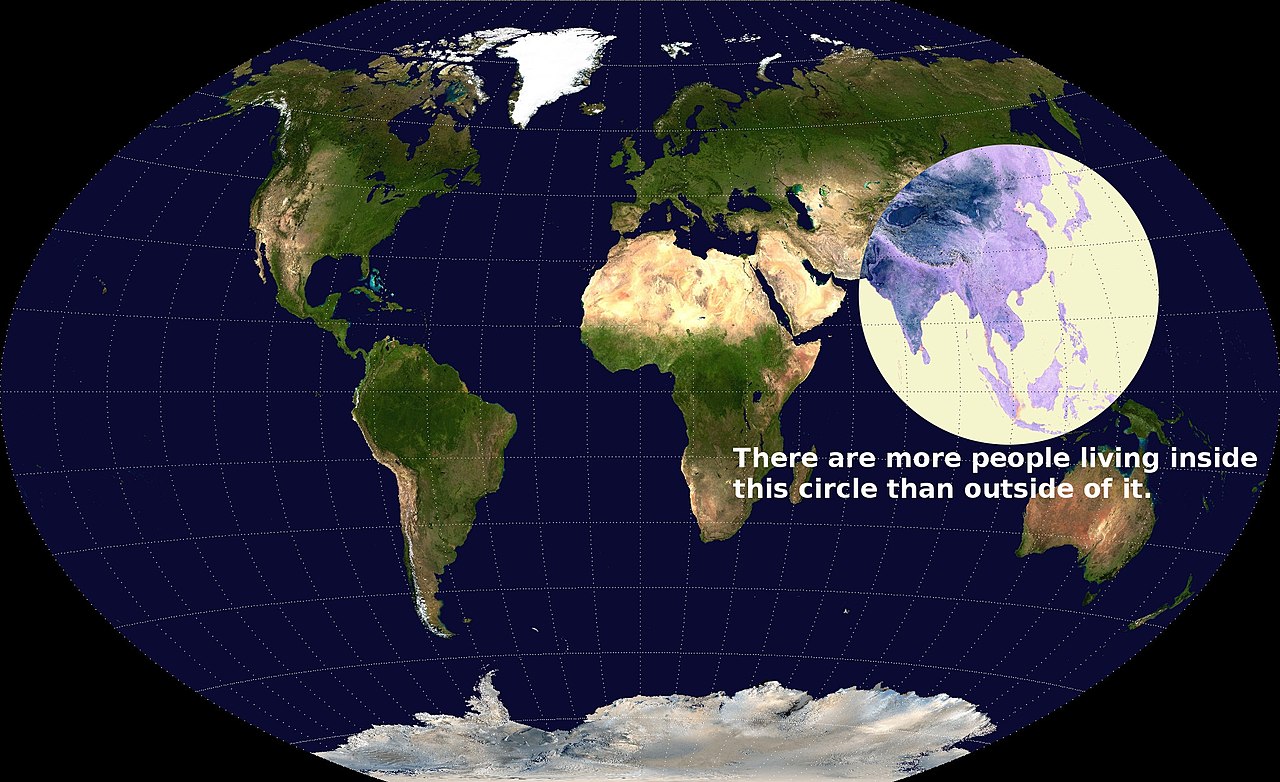
The internet went wild. The Washington Post featured it. Economists verified it. A professor at the London School of Economics, Danny Quah, refined the calculation and found that the smallest circle containing half the world's population has a radius of about 3,300 kilometers — centered near a township in Myanmar, less than 300 kilometers north of Chiang Mai. Today, that circle holds 4.2 billion of the world's 8 billion people.
This circle is called the Valeriepieris circle.
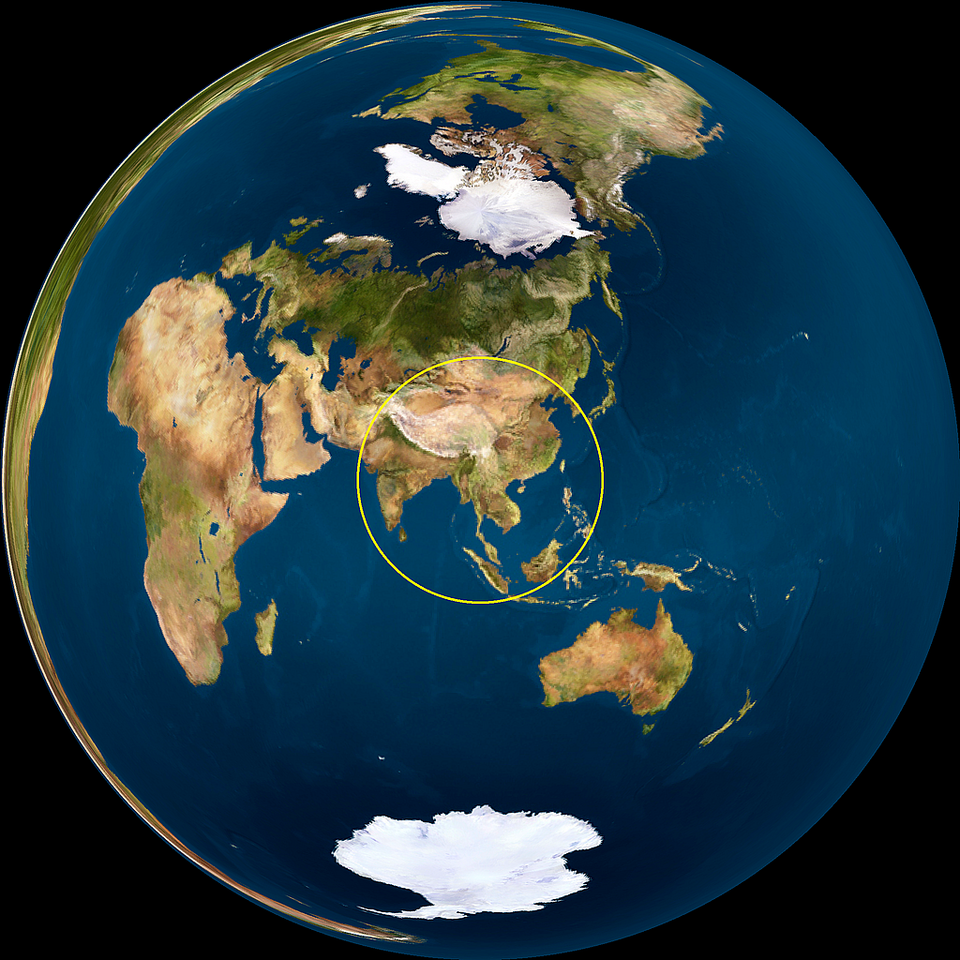
Most people who grew up in this region have never heard of it. We were taught to look outward — toward the West, toward markets that felt more prestigious, toward places with a longer track record. Meanwhile, more than half the world was already here.
Add to this: ASEAN is now on track to become the fourth-largest economy in the world within a few years. Behind only the US, China, and India. This has never been true in our lifetimes. Selling within Southeast Asia is already doing global business — in a way that simply was not the case a generation ago.
A global mindset starts with this: seeing clearly where you are standing, before deciding where you need to go.
The second part of global mindset is learning to operate across difference without losing your footing. Things will not always make sense from your default frame — and that disorientation is the signal to get curious, not frustrated.
A simple example. On a Chinese stock exchange display, rising stocks are shown in red. Falling stocks are shown in green. To anyone trained on Western financial conventions, this looks backwards.
But in Chinese culture, red is the color of luck and prosperity. Green carries different associations. The display is not wrong. It makes complete sense — once you understand whose frame it was designed for.
You will hit versions of this constantly when building across cultures. A pricing model that works in Thailand fails in Vietnam. A message that builds trust in one market reads as pushy in another. The global entrepreneurial mindset does not require knowing all these answers in advance. It requires staying curious long enough to find them.
The last piece of the mindset — and the one that separates people who talk about global opportunity from those who actually move on it — is the willingness to keep going when nothing seems to be working.
I want to tell you a short story.
When I was an undergraduate at USC, I overheard a senior alumni mention that years earlier, a group from our university had gotten lunch with Warren Buffett. He did not know the details. That was enough for me to start.
I tracked down who had gone. Met them. Got the contact. Sent an email to Berkshire Hathaway. Silence. Followed up. More silence. Waited months, tried again. Got a reply that the program was full that year. My friends thought that was a no. I read it as: full this year means there is a next year. Put a reminder in my calendar and emailed again twelve months later.
Eventually, two years after the first email, I got a reply: call me at this number. The program was for MBA students. I was an undergraduate. I said yes to everything and figured it out afterward. We ended up in Omaha, got lost multiple times, arrived last — and I sat directly across the table from Warren Buffett at lunch.
Every step in that story was ordinary. Ask who someone knows. Follow up when they forget. Find the contact yourself. Say yes before you have all the answers. Show up before everyone else.
None of it required a special background. It required one thing: the assumption that the room was worth getting into, and that silence was not the same as no.
That assumption — applied to markets, to customers, to partnerships across borders — is what global entrepreneurial mindset looks like when it is actually running.
Global: you know where the world's people and economic growth actually are. You do not assume the most important markets are the ones that feel most familiar.
Entrepreneurial: you see possibility before you see obstacles. You move before you have certainty.
Mindset: you recognize when your default assumptions are local and revisable — and you stay curious long enough to find the logic on the other side.
These three do not work in isolation. A global perspective without the bias to act is just geography. An entrepreneurial drive without cultural awareness is just noise in foreign markets. A fixed mindset, however talented, will not survive the kind of ambiguity that building across borders requires.
Together, they are the foundation of everything else in this program.
A note for GVP students
Read this before or after class — it is designed to work either way.
Block B is about understanding yourself. Before that exercise means anything, it helps to understand the world you are building in and why this moment — this region, this generation — is genuinely unusual.
The Buffett story is not here as inspiration. It is here as a model for what persistence actually looks like. When an interview goes unanswered, when a customer does not reply, when a door seems closed — ask yourself: is this a no, or is it silence?
Then decide what you are going to do next.
Kasper-Tanakrit Sermsuksan is the Founder of SEA Bridge, Dean of SEA Bridge Institute of Entrepreneurship, and a Visiting Lecturer at Chulalongkorn University, Faculty of Engineering (Computer Engineering). Learn more →