Reading time: 7–8 min
The most expensive mistake in venture building is solving the wrong problem well. The Double Diamond framework exists to prevent exactly that — by forcing you to stay in the problem space long enough to actually understand it before you collapse into solutions.
The Double Diamond is a design process framework developed by the British Design Council in 2005, through research across major companies including LEGO, Sony, Microsoft, and Starbucks. It has become one of the most widely used models in design thinking, product development, and innovation — not because it is sophisticated, but because it is honest about something uncomfortable: the problem you start with is almost never the real problem.
The framework describes two diverge-then-converge cycles — hence two diamonds:
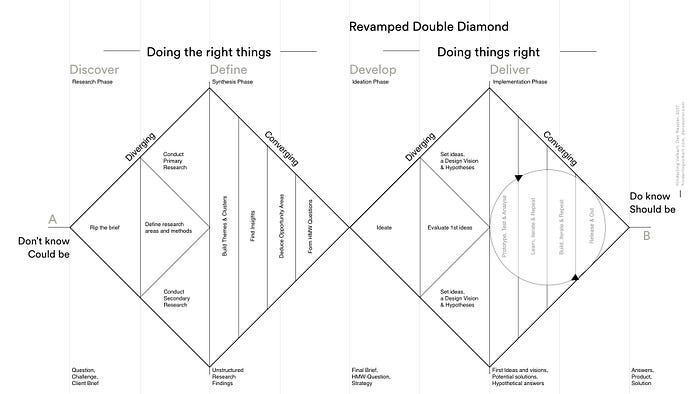
Discover → Define
Broad exploration, open questions, research
Resist the urge to jump to solutions
Output: A clear, validated problem statement
Tools: interviews, ethnography, JTBD, observation
Develop → Deliver
Generate multiple solution directions
Test and refine before committing
Output: A tested, iterable solution
Tools: prototyping, usability testing, pilots
The sequence is critical. You cannot effectively design the second diamond until you have done the work of the first. Most teams collapse both diamonds into one — they arrive with a solution in mind and define the problem to match it. The Double Diamond is a structural reminder that these are two different activities, and that collapsing them produces products nobody wants.
The Discover phase is the most commonly skipped stage in startup building. It feels like procrastination. You have an idea. You want to build it. Research feels like delay.
It is not delay. It is the work that determines whether everything that comes after is pointing in the right direction.
In the Discover phase, you are opening up your understanding of the problem space. You are not looking for your answer — you are trying to understand the landscape well enough to know which problem is worth solving. This means:
The Discover phase should make you uncomfortable. If all your research is confirming what you already believed, you are not discovering — you are shopping for evidence.
After the Discover phase, you converge into a Define phase. You are synthesising what you found and articulating a specific problem statement that is worth solving.
A good problem statement has three qualities:
What you are explicitly not doing in the Define phase is specifying your solution. The problem statement should be solution-agnostic. 'Small restaurant owners in Bangkok spend 3–5 hours per week manually managing ingredient orders across 8–12 different suppliers, with no visibility into price changes or inventory levels' is a problem statement. 'We need to build a procurement app' is a solution statement dressed as a problem.
The difference matters enormously. A clear problem statement allows you to evaluate multiple potential solutions. A solution statement locks you into one approach before you know whether it is the right one.
Define the problem before you define the solution. A sharp problem statement is worth more than a polished prototype.
The Develop phase is where you allow yourself to generate solutions — but the key word is generate, plural. The Develop phase should produce multiple candidate approaches, not one fixed design.
Techniques common in this phase include:
The Google Ventures Design Sprint — made popular by Jake Knapp's book Sprint — is a structured five-day process for running through the second diamond in an accelerated timeframe. It has been used by hundreds of companies to rapidly prototype and test ideas before committing significant resources. The process compresses diverge-and-converge into one intensive week with specific daily activities.
The Deliver phase is where you converge from multiple solution directions into a tested, refined approach. The word tested is critical: the Deliver phase does not mean finished, it means validated to a sufficient standard to justify continued investment.
In early-stage venture building, Deliver means:
Deliver does not mean perfect. It means sufficiently tested to make the next decision — whether to continue building, pivot, or stop — with evidence rather than hope.
Design Thinking is the broader philosophy in which the Double Diamond lives. It is a human-centered approach to problem solving that prioritises deep empathy with users, rapid experimentation, and iteration over premature optimisation.
Its five stages — Empathize, Define, Ideate, Prototype, Test — map closely to the Double Diamond, with an explicit emphasis on empathy as the foundation of everything. You cannot design for someone you do not understand. The empathy work is what makes the research in Block C non-negotiable, not optional.
Traditional analytical approaches move linearly: define the problem, generate solutions, evaluate options, select the best one. Design thinking assumes the problem definition itself is uncertain and treats the entire process as iterative. You define, test, learn, redefine, test again.
This is why early-stage research should inform your problem statement rather than simply validate it. If your customer interviews are changing your understanding of the problem, that is the process working correctly. If your customer interviews are confirming exactly what you expected, either you started with genuinely strong insight, or you are not listening carefully enough.
The Block C work you are doing right now is the first diamond. You are in Discover and Define. The interviews, the JTBD exercise, the competitive map — these are all discovery tools. The problem brief you will write is your Define output.
You will not do the second diamond fully until later blocks, when you have validated the problem well enough to start generating and testing solutions. This is not a curriculum design choice — it is the correct order of operations. Founders who jump to the second diamond too early build products that are well-designed solutions to the wrong problem.
I have seen it in every cohort: a team arrives to Block C with their product already half-designed in their heads. They go through the interviews looking for confirmation. They write a problem statement that is really a feature list. They skip the real work of discovery because they are impatient to build.
The teams that do this consistently produce pitches in Block G that sound confident but fall apart under one or two honest questions. The problem is shallow. The customer insight is thin. The solution cannot be distinguished from a dozen similar products.
The teams that do the double diamond properly — staying genuinely uncomfortable in the Discover phase, writing a problem statement that is specific and evidence-based — produce pitches that are different. They know their customer more precisely. Their solution is more targeted. They can answer hard questions because they have already asked harder ones of themselves.
Discovery is not delay. It is the investment that makes everything after it faster.
✎ A Note for GVP Students
Kasper-Tanakrit Sermsuksan is the Founder of SEA Bridge, Dean of SEA Bridge Institute of Entrepreneurship, and a Visiting Lecturer at Chulalongkorn University, Faculty of Engineering (Computer Engineering). Learn more →