



By Kasper-Tanakrit Sermsuksan · Global Venture I: Playbook · Block A
You are here: A-04 · Block A · Orientation & Mindset · article 4 of 10 · Form A+B · Next: A-05 About Global Venture I: Playbook
In short: Start a company when at least one real reason is yours and you can honestly face the 29 "not yet" lines below. It is a self-check, not a yes-or-no verdict. Having a good idea is not the reason. The real reasons are these: you want to change something, you want to build something people love, or you want to win. One reason is enough to begin. Clear the common myths out of your head first.
Try it in 10 minutes: Set a timer. Read the 29 lines below once, fast. Copy the three that made you flinch. Next to each, write "no" or "not yet" — and the name of one person who could help you with it.
Whenever people find out I work in startups, the questions start.
Friends ask. Younger colleagues ask. The biggest question is always some version of this one: should I start a company?
I don't think anyone can answer that for you with a yes or a no. Not me. Not your parents. Not an investor.
Starting a company is one of the most interesting things you can do with your time. It is also one of the most demanding.
So instead of an answer, here is a list.
It is not designed to stop you. It is designed to prepare you.
How do you know if you should start a business?
Start with what should make you wait. Not yet — if any of these sound like you.
- No, if you think the hard part is coming up with the idea.
- No, if you need people around you to believe in it before you can move.
- No, if you are not ready to hear "I don't think this will work" from someone whose opinion you respect — and keep going anyway.
- No, if you want credit for the work before the work is done.
- No, if you are expecting your co-founder to be easy to work with.
- No, if you think you can do it alone.
- No, if you are not prepared for loneliness. Not the romantic kind — the specific loneliness of carrying a version of the future in your head that no one else can fully see yet.
- No, if you expect people to get it right away.
- No, if rejection is going to stop you.
- No, if you need a clear path before you can start walking.
- No, if you are not willing to do the embarrassing version first — the rough pitch, the ugly prototype, the cold message to a stranger.
- No, if you are only in it for the outcome and not the process.
- No, if you need the people closest to you to think it is a good idea.
- No, if you are not ready for the people closest to you to worry about you.
- No, if you are expecting it to feel like momentum most of the time. It mostly feels like resistance.
- No, if you are not comfortable being wrong in front of people.
- No, if you think a good idea protects you from a bad market.
- No, if you cannot explain who pays you and why.
- No, if you have not talked to real customers yet — not friends, not family, not people who want to be supportive.
- No, if you are building to prove something to someone.
- No, if you are not ready for the version of yourself that shows up at 2am when things are not working.
- No, if you think passion is a substitute for preparation.
- No, if you need certainty before you can act.
- No, if you are not ready for the rollercoaster — the kind where you feel like a genius on Tuesday and question everything by Thursday.
- No, if you are waiting for the right time.
- No, if you are not ready to sell — your idea, your vision, your product — to people who did not ask to hear it.
- No, if success means being understood by everyone. Most people will not understand what you are building until it works.
- No, if you are not ready to ask for help.
- No, if you are not ready to be changed by it.
If you read this list and still want to start — that clarity is your answer.
And if three or four lines hit you hard, good.
That is not a "no". It is a "not yet". And now you know exactly what to work on.
I have watched a "not yet" turn around in class. One student wrote in a reflection at the end of the 2026 course that a close friend had dropped the class, and they had nearly done the same. They stayed. By the last week, they felt they had got past their own doubts — and past their introversion.
That is what a "not yet" looks like when you work on it.
What do most people get wrong about startups?
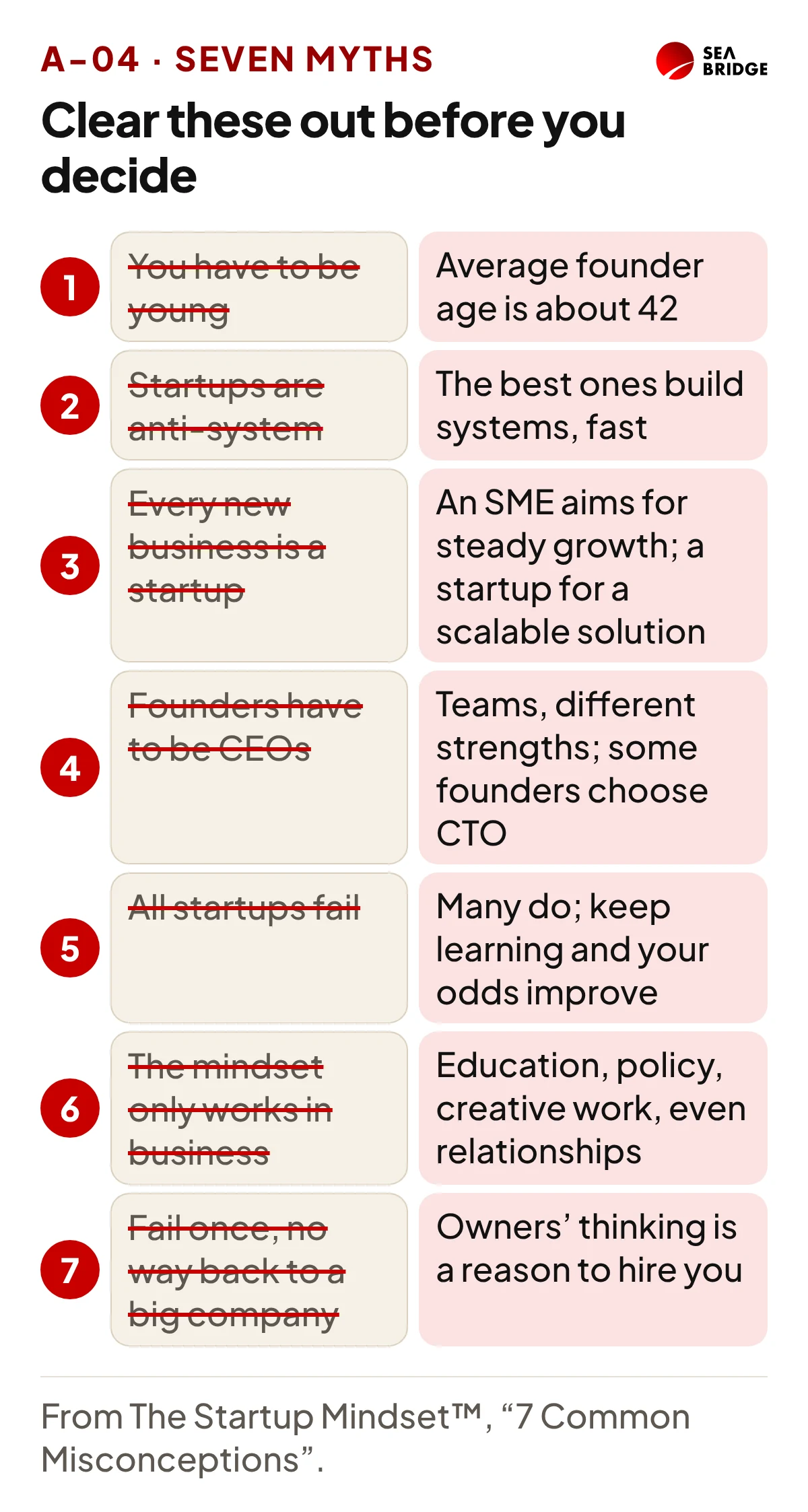
Most of the questions I get come from seven myths. I open my book with them, because you cannot decide clearly while they are still in your head (The Startup Mindset, "7 Common Misconceptions").
1. "You have to be young."
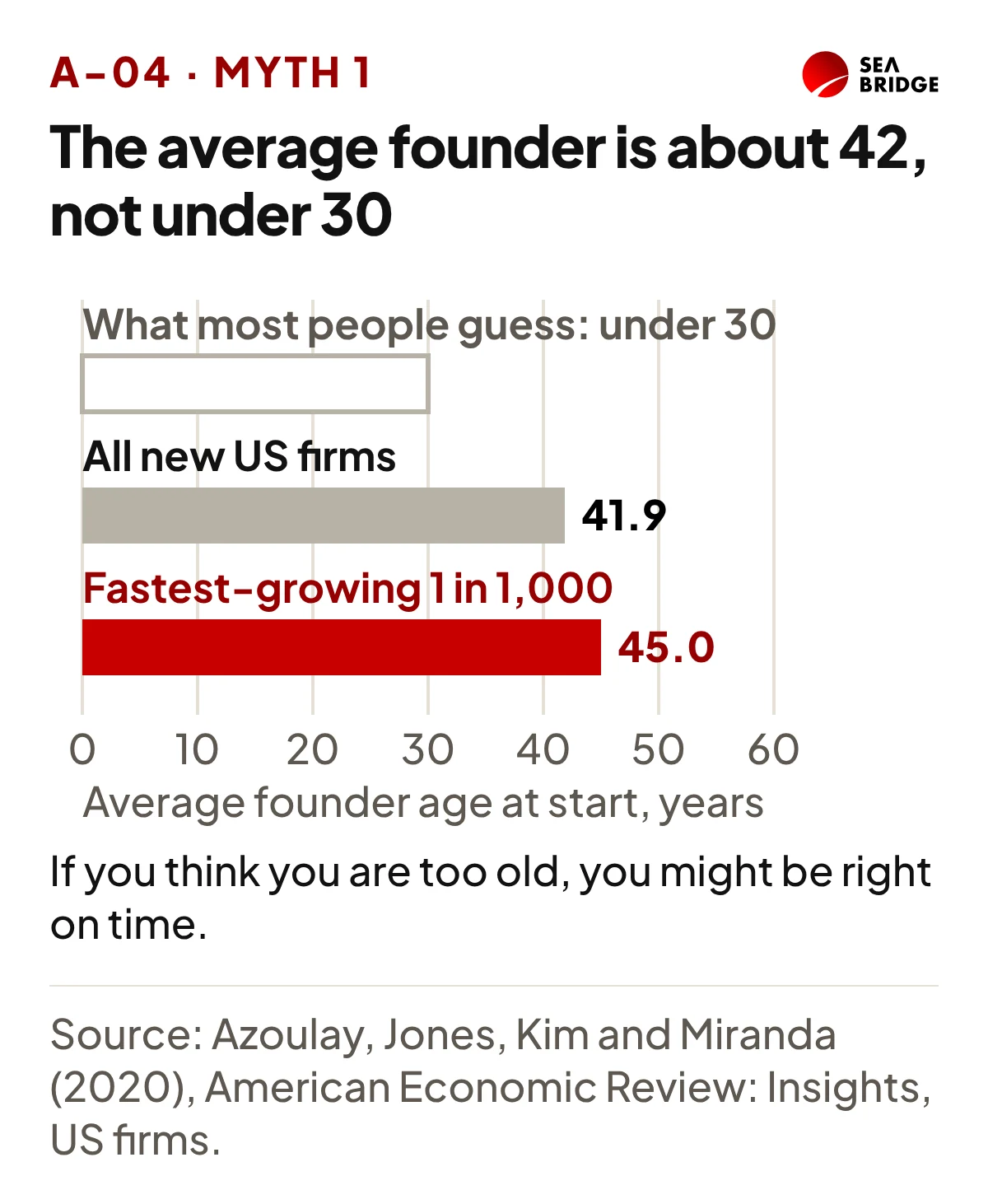
In my workshops I ask: what is the average age of a startup founder? Most people guess under 30.
A large US study found the average founder of a new company was about 42 when they started it — and the founders of the fastest-growing firms were older still: 41.9 on average across all new US firms, and 45.0 for the fastest-growing one in a thousand1.
In my experience, many founders spend years in regular jobs first, spot a problem, and then decide to fix it.
If you think you are too old, you might be right on time. If you think you are too young — you are starting early, which is its own advantage.
2. "Startups are anti-system."
People picture chaos. In reality, the best startups are the ones that learn to build systems — fast.
Early days are messy. But the goal is always a backbone for growth.
3. "Every new business is a startup."
Every startup is a new business, but not every new business is a startup.
An SME usually aims for steady growth. A startup aims for a scalable solution to a problem many people share. Both are honorable. They need different plans. See Startup vs. SME.
4. "Founders have to be CEOs."
Not true. A friend of mine — let's call him Hans — is a software engineer. He started a company but chose to be CTO. For him, a great CTO was harder to find than a great CEO.
Startups are built by teams with different strengths. Your job is to find yours: see TeamFlow™ and the 4H Founder Archetypes.
5. "All startups fail."
Many do. But the few that work can change everything — think Grab, Gojek, Airbnb.
If you keep learning, adapting and getting back up, your odds get much better.
6. "The startup mindset only works in business."
It works in education, policy, creative work, even relationships.
When I wrote my book, I used it too: prototype, test, get feedback, iterate. If nobody wants your book, it does not matter how good the writing is.
7. "If you fail at a startup, you can't go back to a big company."
These days, companies are desperate for people who think like owners.
If you have run something — even something that failed — you know how to stretch resources, make tough calls and move fast. That is not a gap in your CV. It is a reason to hire you.
Why start at all?
The list above tells you what to be ready for. It does not tell you why anyone should bother.
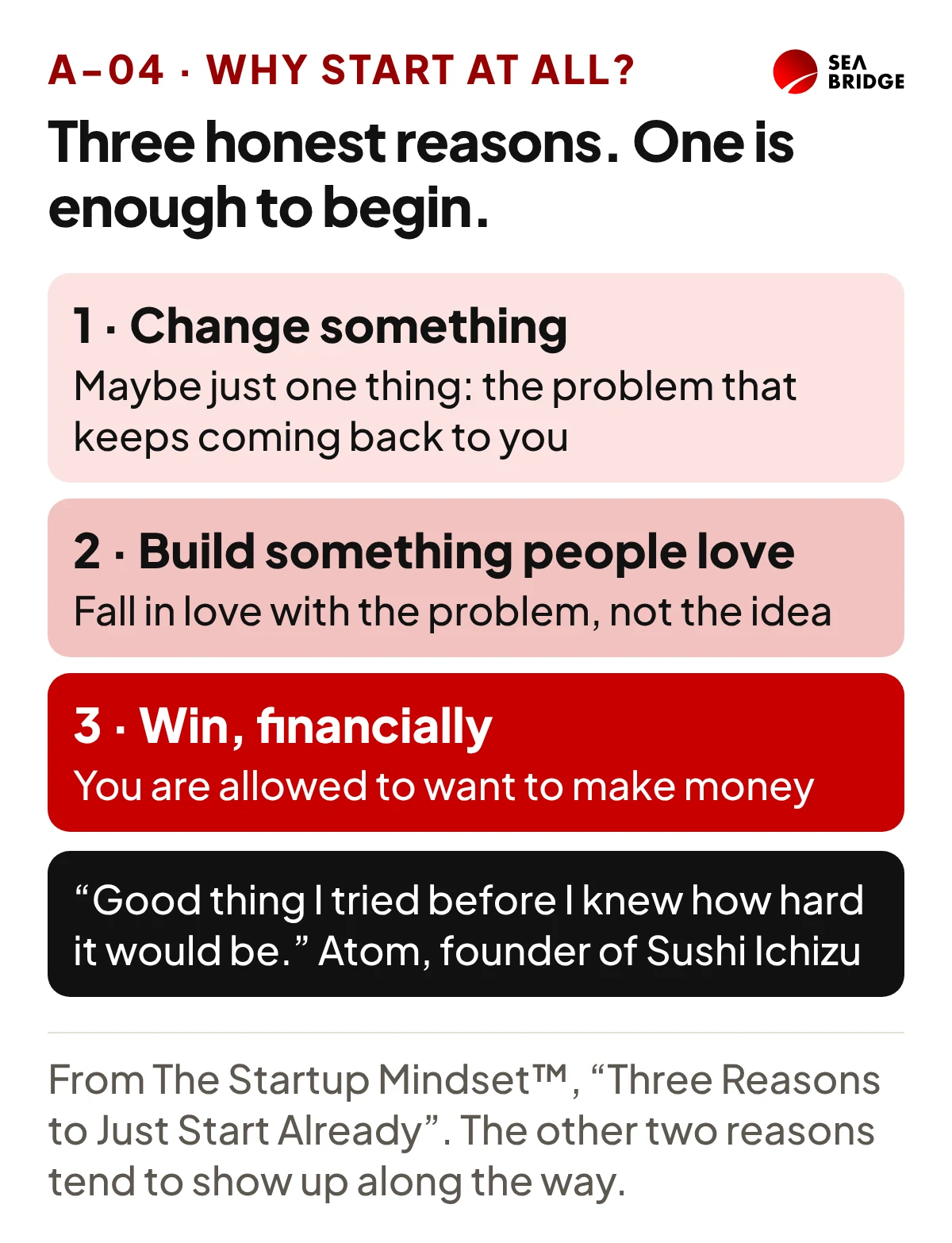
So here are the three honest reasons I end my book with. Not the polished version founders say on stage (The Startup Mindset, "Three Reasons to Just Start Already").
1. You want to change something. Not the whole world. Maybe just one thing. The problem that keeps coming back to you in the shower. The gap that frustrates you every single time you bump into it. That feeling is not random. It is a signal.
2. You want to build something people actually love. Not something good enough. Something people cannot imagine living without. That bar is high. The founders who reach it do not fall in love with their idea — they fall in love with the problem.
3. You want to win — financially, not just spiritually. You are allowed to want to make money. Real money. That is not a dirty motivation. It is an honest one. The founders I have seen burn out fastest are often the ones who told themselves they did not care about the financial side.
Most people start with just one of these three. That is fine. One is enough to begin. If you are doing this seriously, the other two will show up along the way.
One warning about lists like mine. Don't let them make you wait until you know everything.
On a work-from-anywhere trip to Loei, I fell in with a new group of friends. One evening, I heard the story behind one of Thailand's first true omakase restaurants. Atom was 24, just back from a master's in England. He loved omakase, and he could not get a seat anywhere in Bangkok. So he decided to solve his own problem.
He had never run a restaurant. He barely knew anyone in Japan. He went anyway, and spent almost two years looking for a chef.
Every established chef said no. "You should lower your standards," people told him. "It'll be easier."
He refused. He started asking the assistant chefs instead. One, from a two-Michelin-star restaurant, finally said yes. That stubbornness became Sushi Ichizu.
When I asked Atom whether he knew what he was doing at the start, he laughed. "I didn't have a clue. But I was too stubborn to give up."
Then he said the line I still think about: "Good thing I tried before I knew how hard it would be. If I'd known more, I might never have opened the place."2
That is why this list asks "not yet", not "never". Prepare for the hard parts. Then start before you know enough to be afraid.
How do I use this self-check?
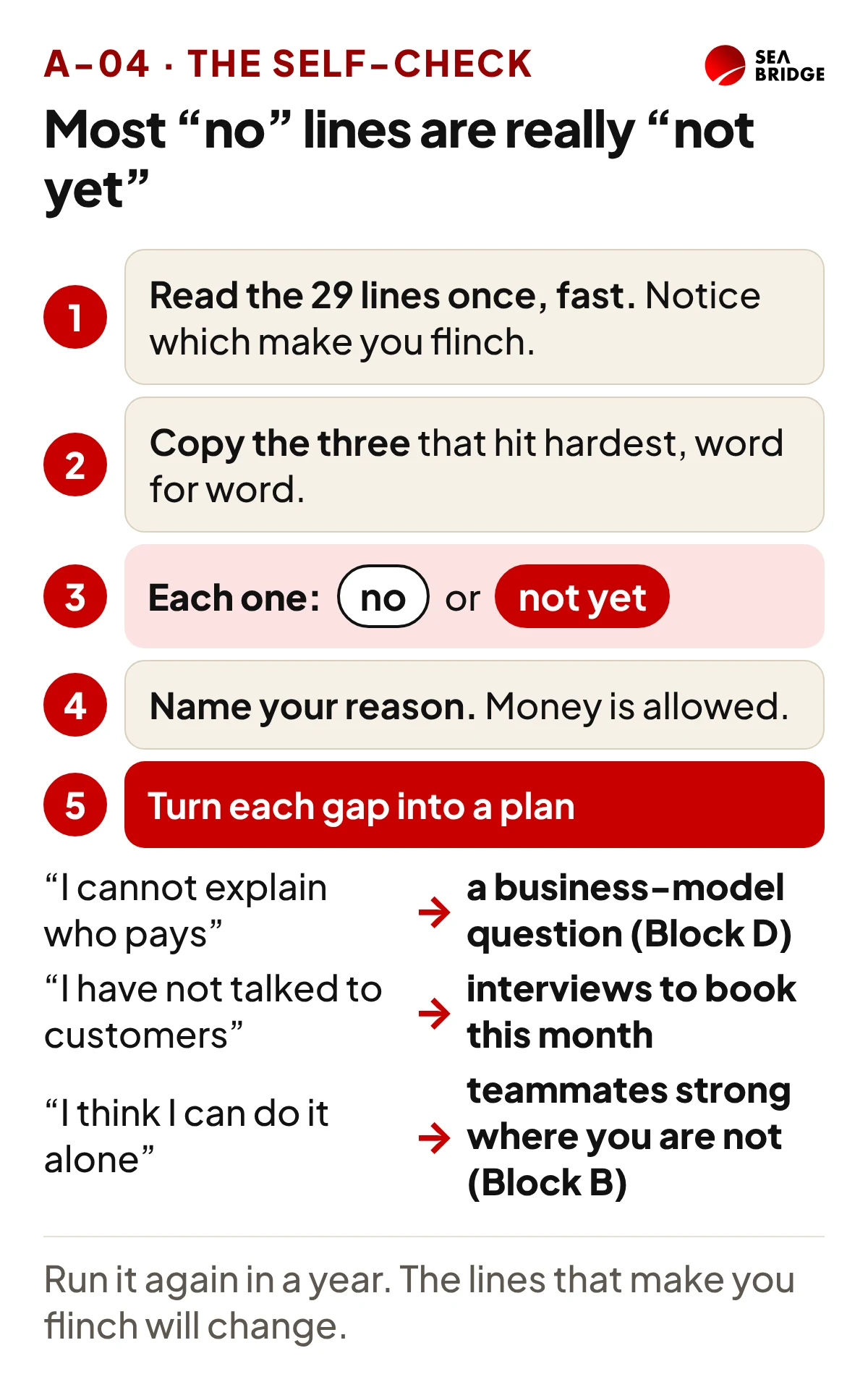
- Read the 29 lines once, quickly. Do not think. Just notice which ones make you flinch.
- Pick the three that hit hardest. Write them down, word for word.
- For each one, ask: is this a "no" or a "not yet"? Most are "not yet" — a skill, a habit or a person you are missing.
- Name your reason. Which of the three reasons is yours today? Be honest. Money is allowed.
- Turn the gaps into a plan. "I cannot explain who pays" becomes a business-model question to answer. "I have not talked to customers" becomes a list of interviews to book this month. "I think I can do it alone" becomes a search for teammates who are strong where you are not.
I recommend running this check again a year from now. The lines that make you flinch will change.
Frequently asked questions
How do I know if I should start a company?
When you can be honest about the hard parts — rejection, loneliness, uncertainty, selling — and still want to do it, and when you have at least one real reason: to change something, to build something people love, or to win financially.
Am I too young or too old to start a startup?
Neither, usually. Research in the US puts the average founder's age at around 421. Starting young is a head start, not a disadvantage.
When is the right time to start a business?
When you have one real reason, you have named your "not yet" lines, and you have a plan to work on them. Waiting for the perfect time is itself one of the 29 lines.
Should I start a business or get a job first?
Either can work. Many founders spend years in regular jobs, spot a problem, then build. And if a startup fails, companies value people who have run something. What matters is that you keep learning either way.
Do I need a great idea first?
No. The idea is the easy part. Evidence that real customers have the problem is the hard part — and it can be learned.
What if I don't want to be the CEO?
You don't have to be. Many founders lead product, technology or operations and bring in a partner to run the company.
✦ A Note for Global Venture I Students · Block A: Orientation & Mindset · Form A+B
Some of you already know. Some of you are still figuring it out. Both are fine starting points.
If you already have a startup idea, you can bring it — as long as you can show early evidence of a real problem (Customer readiness, CRL 3: direct feedback from people who have the problem) and convince me in Form A+B. If you don't, you will start from a SEA Bridge sector or answer Thailand Longevity Ventures' Call for Ventures. See Choosing Your Challenge.
What this course will do is help you get honest — about what you have (FISHE Capital™ × CSTO™ Personal), what you are missing, and what kind of builder you actually are (TeamFlow™). That clarity is worth more than any idea you walk in with.
Where your gaps get worked on: "I cannot explain who pays" becomes Block D. "I have not talked to customers" becomes your twelve interviews. "I think I can do it alone" becomes your team work in Block B.
Do this before class:
- In your Venture update (Form A+B), write the three lines from the list that hit you hardest, and for each, "no" or "not yet".
- In your Book Log, log the 7 Misconceptions: which myth did you believe, and what changed when you read it?
- Write one sentence: which of the three reasons is yours today?
Pre-class check (in Form A+B):
- Name two of the seven misconceptions and why each is wrong.
- What are the three reasons to just start, and which one is enough on its own?
- Pick one line from the self-check and explain which block of this course will help you with it.
Your progress: Team readiness — baseline: you name your own gaps before the team plan in Block B (target team readiness 3–4 by the end of the course). How we measure progress
Skills you practice: Motivation and self-awareness · self-awareness and self-efficacy.
Based on the KTH Innovation Readiness Level™ by KTH Innovation, licensed CC BY-NC-SA 4.0 (kthinnovationreadinesslevel.com).
Keep reading
- About Global Venture I: Playbook — How the Course Works — the rules (next in Block A)
- Startup vs. SME — myth 3, in full
- FISHE Capital™ × CSTO™ (Personal Edition) — what you have, and what you are missing
- Letters to Future Self — come back to your reason at the end
All articles in Block A · Orientation & Mindset
- A-01 The Story Behind SEA Bridge
- A-02 Can Entrepreneurship Be Taught?
- A-03 SEA Bridge: The Cross-Border Venture Studio
- A-04 Should You Start a Company? (you are here)
- A-05 About Global Venture I: Playbook
- A-06 The Entrepreneur Interview
- A-07 Thank-You Letters
- A-08 The ASEAN Friend Interview
- A-09 How to Choose a Startup Idea
- A-10 How to Keep a Startup Journal
References
- Azoulay, P., Jones, B. F., Kim, J. D., & Miranda, J. (2020). Age and high-growth entrepreneurship. American Economic Review: Insights, 2(1), 65–82. https://doi.org/10.1257/aeri.20180582 (journal page: https://www.aeaweb.org/articles?id=10.1257/aeri.20180582; the 41.9 figure was checked in the authors' 2019 working-paper draft: https://www.kellogg.northwestern.edu/faculty/jones-ben/htm/Age%20and%20High%20Growth%20Entrepreneurship.pdf) — accessed Nov 2026.
- Sermsuksan, K.-T. (2023). The Startup Mindset [in Thai], "7 Common Misconceptions", Chapter 2 and "Three Reasons to Just Start Already". Wish Publishing (สำนักพิมพ์วิช). English: the author's own translation, not yet published.
About the author: Kasper-Tanakrit Sermsuksan is the Founder of SEA Bridge and a Visiting Lecturer in Computer Engineering and Digital Technology at Chulalongkorn University's Faculty of Engineering. Learn more →