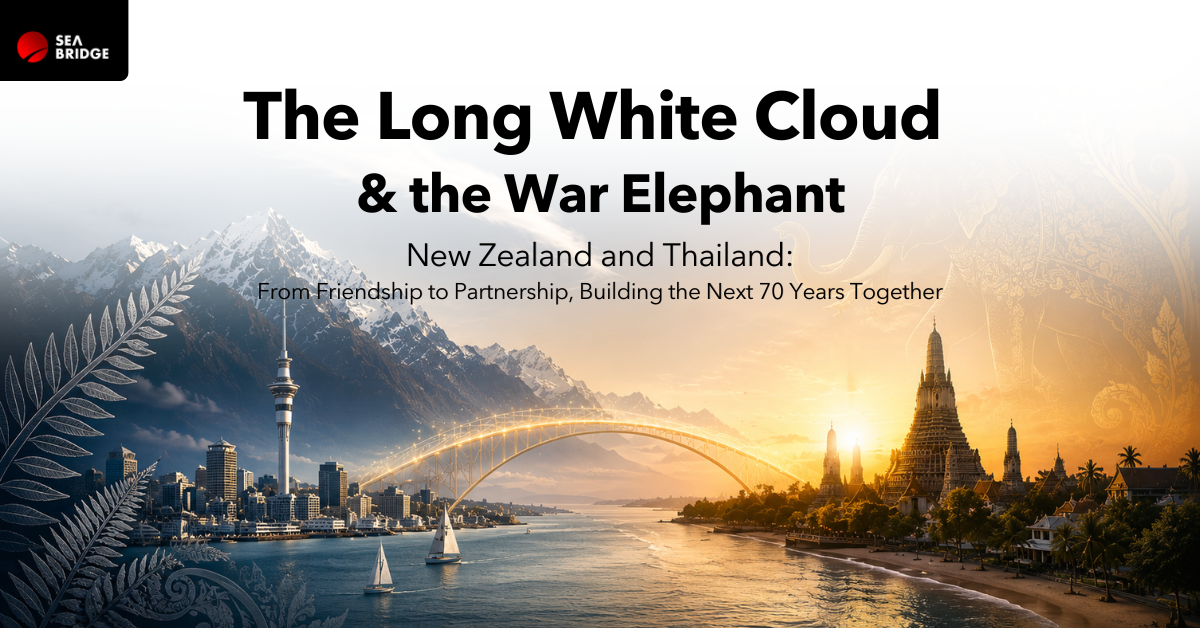
Thailand and New Zealand: seventy years a friend, the next seventy, a partner.
A compressed version of the article is published on Asia New Zealand Foundation website.
Looking out the window as my plane lifts off from Christchurch to Auckland, I see a long, straight coastline below, drawn by the wind into a clean line. It looks exactly like the coast of Chumphon, where I watched the same horizon on my way home from speaking to the fourteen Southern Chambers of Commerce. For a moment the two countries fold into one image, and the 9,400 kilometers between them stop feeling like distance and start feeling like an old friendship we never quite finished building.

I work with founders and build companies for a living. As the Founder of SEA Bridge, a cross-border venture builder, I work toward one mission: to help educate and support one million entrepreneurial talents across ASEAN, solving local problems while creating global impact. I came to New Zealand as Thailand's delegate to the Asia New Zealand Foundation's Young Business Leaders Initiative (YBLI), five days hosted with extraordinary care. It was my first time in Aotearoa, the Land of the Long White Cloud. I arrived a stranger, and I am leaving in debt to the place and its people. This piece is how I begin to repay it.
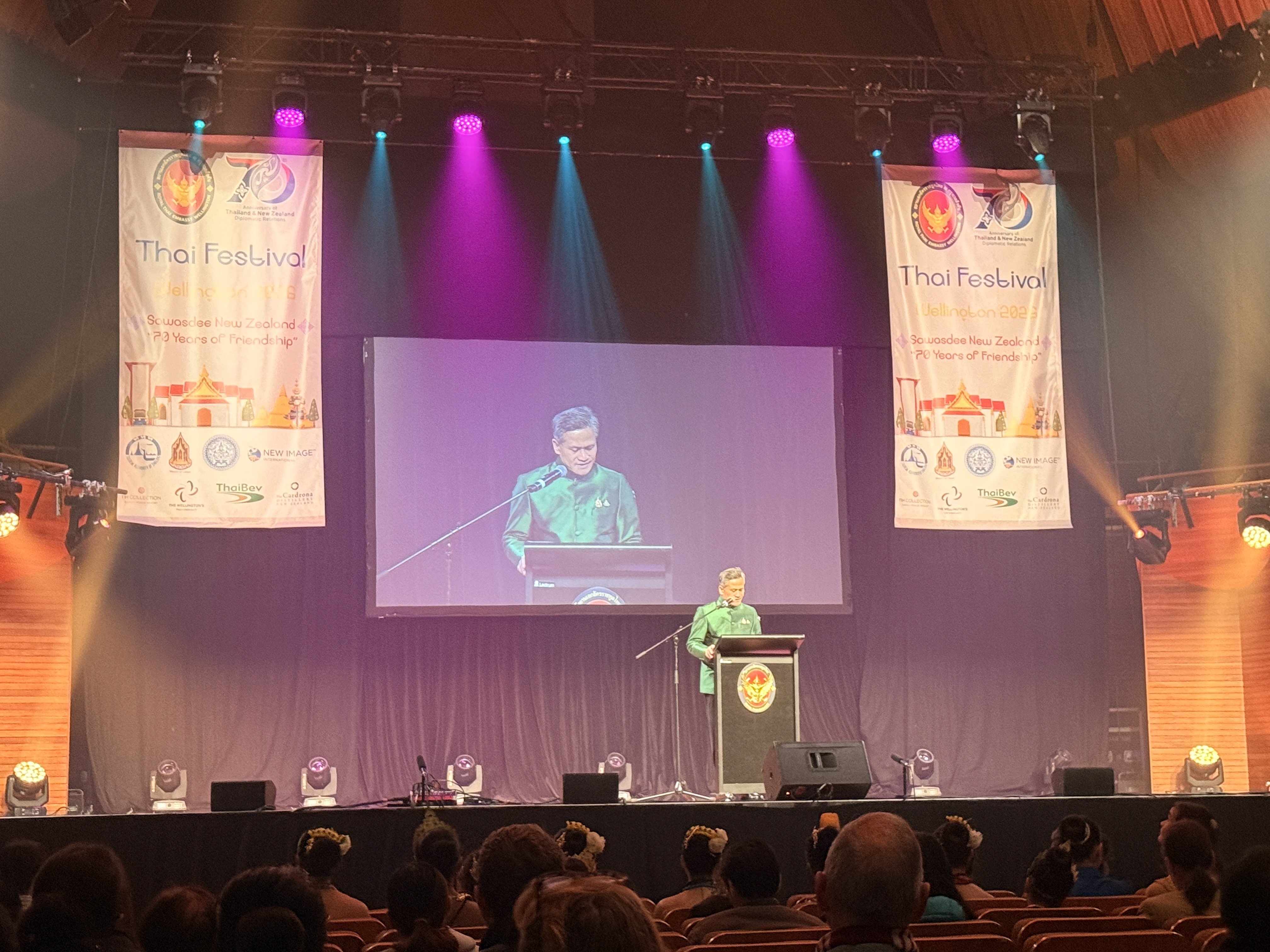
In 2026, Thailand and New Zealand marked seventy years of diplomatic relations, and both Prime Ministers have committed to a Strategic Partnership [1]. The friendship runs deep. King Bhumibol visited in 1962, five years before ASEAN even existed, and when he passed in 2016, New Zealand flew its flags at half-mast on the Auckland Harbour Bridge [2] [3] [4]
And yet, after seventy years, we still do not know each other the way old friends should. We trade a little, visit a little, and admire each other from a distance. The most generous thing two friends can do at a milestone like this is not to count what they have built, but to imagine what they could.
The shift worth making is simple: from two countries that are friendly, to two peoples who build together.
I believe entrepreneurship is the finest bridge between them, because building a company is hard for everyone, everywhere, in exactly the same way. A Thai founder and a Kiwi founder who have both lain awake at 3 a.m. over payroll understand each other faster than two diplomats ever will. The struggle is a shared language that needs no translation.
And our values already rhyme. At one Auckland breakfast I watched a founder describe bootstrapping a travel app to tens of thousands of users with no outside money, the room nodding like a congregation. At the University of Auckland's innovation center, the people who help students raise capital spoke about the students before they spoke about the returns. In Christchurch, a city that rebuilt itself after the 2011 earthquakes, I saw a place that knows how to begin again. Everywhere I went I found the quality I prize most in the best ASEAN founders: disciplined courage, the will to do hard, unglamorous work for a long time without applause.
On my first day, the Foundation took us through the All Blacks Experience. I have never followed rugby, yet I felt the weight of that black jersey. For New Zealand, black is not the absence of color. It is seriousness, the quiet confidence of a small nation that decided to be the best in the world at something, and then was.

Thailand's recurring color is white: the white elephant once reserved for kings, the Buddhist robe, the band of purity on our flag. White, for us, is openness and welcome, a canvas of colors not yet painted.
Black and white do not compete. They complete each other, two halves of one circle, each carrying a seed of the other. New Zealand could borrow a little Thai warmth; Thailand could borrow a little Kiwi grit. We already share more than the map admits: a reverence for land, family, and faith; the hongi and the wai; and a Thai community in New Zealand that has grown from 41 people in 1961 to an estimated 50,000 of Thai descent today [5]. From Ayutthaya to Aotearoa, we are more woven together than the distance suggests.
We even share the same quiet problem. A record 72,700 New Zealanders left the country in the year to September 2025. Thailand's population is now shrinking, having become a "fully aged society" in 2024, and could halve within fifty years [6] [7]. Neither of us can grow our way out of this alone.
Each of us has exactly what the other is short of.
At the New Zealand Hi-Tech Awards, Marian Johnson, chair of the Hi-Tech Trust, said something that has not left me: New Zealand's founders are held back less by a shortage of ability than by an excess of humility, where their American peers are propelled by ambition. The same is true of Thai founders, and of most of ASEAN. We are raised not to stand out. Thais call it kreng jai, the reluctance to impose. New Zealanders call their version "tall poppy syndrome." We suffer from the same beautiful, limiting modesty, which is exactly why we understand each other instantly, and exactly why we are the right ones to push each other.
So here is a provocation, the kind only a cousin may make.
To my Kiwi friends: be a little spicier. The first time you eat real Thai food, the chili hurts. Your eyes water. By the third meal, you cannot live without it. Spice is discomfort that turns into appetite. Your own Southeast Asian neighbors recently called you a close, like-minded friend and asked you to be more present in the region, especially in education [8]. The appetite for you is already there. What is missing is the willingness to turn up the heat.
To my Thai compatriots: be a little cooler. New Zealand is cold in a way we are not built for, and the honest answer to cold is not to retreat indoors. It is to put on another layer, grow a thicker skin, and walk out into it anyway. We are wonderful hosts and timid guests. It is easy to get a Thai to vacation in New Zealand; it is hard to get one to live, work, and build something there. The next seventy years asks us to be as brave abroad as we are gracious at home.
If we are serious about building the next seventy years instead of commemorating the last, we should do what serious partners do, and write the plan down.
There is a working model next door. In 2023, Australia published Invested: Australia's Southeast Asia Economic Strategy to 2040, a plan with a Special Envoy accountable for delivering it [9]. It proved a middle power can set a serious, long-horizon direction for itself in this region and then act on it. Thailand and New Zealand have nothing like it pointed at each other.
So here is the proposal: a bilateral roadmap, owned by both governments and aimed at 2046, when our friendship turns ninety. Not a fresh bureaucracy, but a plan that runs through the institutions we already have, New Zealand's Ministry of Foreign Affairs and Trade, New Zealand Trade and Enterprise, and Education New Zealand on one side; Thailand's Ministry of Foreign Affairs, the Board of Investment, and the Ministry of Higher Education, Science, Research and Innovation on the other.
The strategic logic makes it more than sentiment. Thailand and Indonesia are the only two ASEAN countries currently in OECD accession, the process of meeting the standards of the world's club of high-governance economies [10]. As Thailand adopts those standards, it becomes the most rules-aligned, predictable place to do business in the region, the natural anchor for a principled, independent New Zealand. And Thailand, at the center of mainland Southeast Asia, is the land bridge onward to the Bay of Bengal, China, and India.
Thailand is New Zealand's door to Asia. New Zealand is Thailand's door to the world.
I want to be honest about what this next part is. I am one founder, not a foreign ministry. Consider the four missions below an ignition, not a blueprint, the most useful version of an idea a guest can leave behind. The full roadmap, on trade, security, and climate, belongs to people who know those fields far better than I do. The chapter I can speak to is entrepreneurship and innovation, focused on five sectors where we are strongest together: food and agriculture, space and aerospace, the creative economy, education, and longevity.
One vision, four missions.
People flow: one hundred thousand Kiwis, one hundred thousand Thais
The deepest bonds between countries are not signed; they are lived. They form when someone spends real time on the other side, studies there, builds a company there, gets homesick there, and comes home changed. The program that brought me here, YBLI, has created exactly that kind of bond for about 270 people over fifteen years. The relationships are extraordinary. The scale is far too modest for what the friendship deserves.
Capital flow: triple the trade by backing the founders who can make it happen
Both governments have promised to triple two-way trade, from about NZ$4.5 billion toward NZ$13.5 billion by 2045 [11]. It is a fine headline and, on its own, a slightly hollow one. The tariffs are already gone, the trade is still thin and lopsided, mostly New Zealand dairy going one way and Thai vehicles coming the other, and as one trade expert traveling with us pointed out, inflation alone drifts the number most of the way there. The real barrier was never tariffs. It is that businesses on each side have no partner on the other.
That is a problem capital and people solve, not one more trade agreement. A tariff moves goods once; a joint venture moves goods, people, and ideas for a generation.
Knowledge flow: solve hard problems side by side
Most "knowledge exchange" between countries is one-directional and quietly condescending. The truth between Thailand and New Zealand is a peer exchange, and the point is not to copy each other but to stand shoulder to shoulder on problems neither has fully cracked.
Culture flow: an annual exchange of people, not just protocols
Culture is not decoration around business; it is the operating system that decides whether a partnership survives. A Kiwi who knows how to wai at a Thai table, and a Thai who knows when to wait their turn in a Kiwi room making space for them, are worth more to a venture than another clause in a trade deal. And both countries are quietly asking the same question: New Zealand, what it means to be a Kiwi as the world tilts toward Asia; Thailand, what our place is in a world that no longer waits politely at our door.
One vision. Four missions. One destination: 2046, the year our friendship turns ninety and, if we choose, the year it finally grows up.
New Zealand invested in me, so I will invest back, beginning on this flight home and waiting on no government strategy or closed fund.
The doors between our countries are already open, and closer than they look. At the Hi-Tech Awards, in a single evening, I had a brief word with Prime Minister Christopher Luxon, Finance Minister Nicola Willis, and the Leader of the Opposition, Chris Hipkins. Ceremonial, not substantive, but a quiet sign that this relationship can reach the top table on both sides of politics.
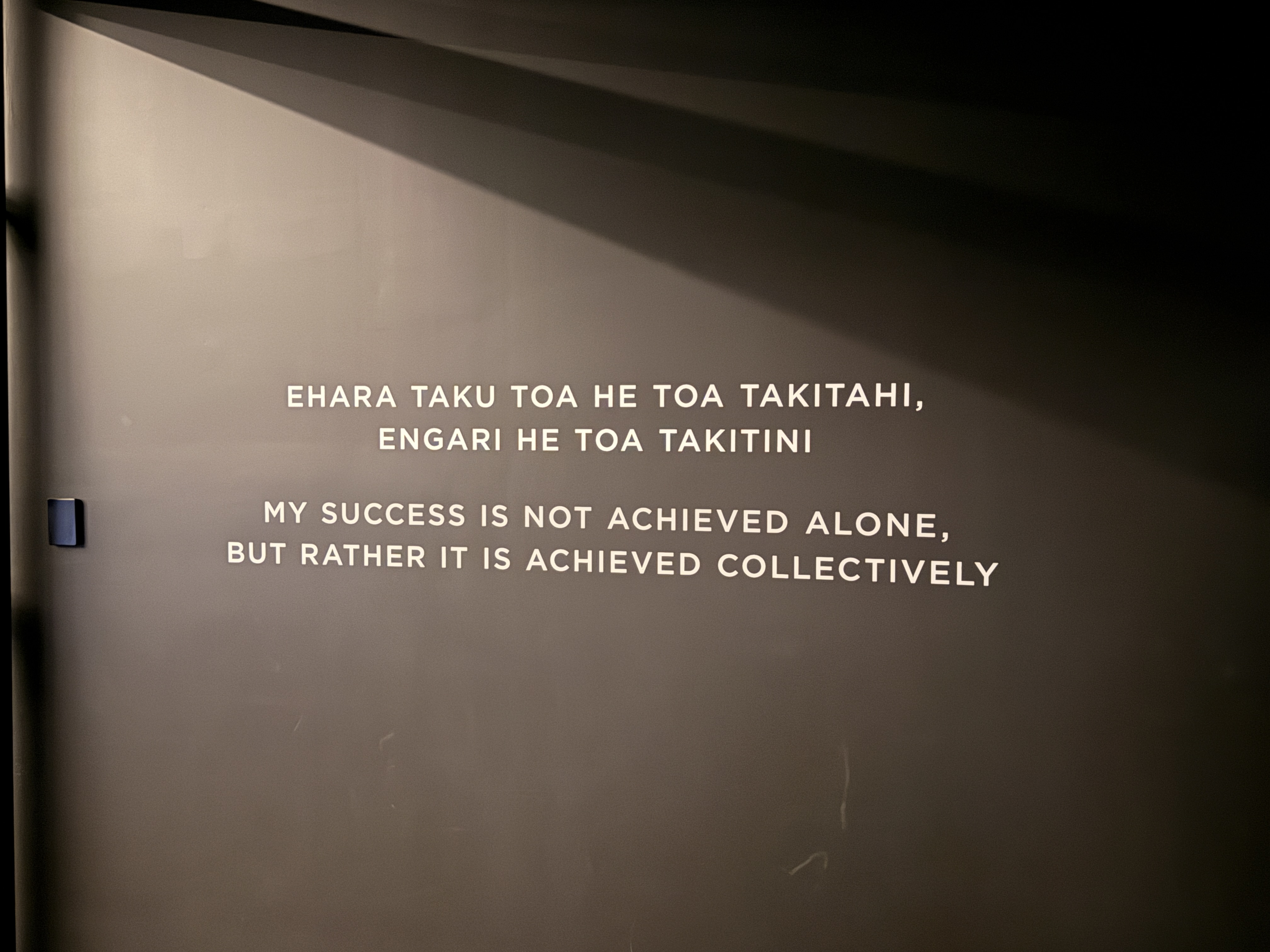
The most valuable thing any of us can give one another is not capital or curriculum. It is an open door. Some doors you can see, and only need an introduction to walk through. Some are invisible until a friend points at the wall. And some do not exist at all until someone who believes in you decides to build one.
I came to New Zealand to learn, and I am leaving in its debt. The next seventy years should be one of the best, not because we say so, but because we choose to build it.
For seventy years, we have been good friends, the next seventy, we should be a partner.
We are starting. Come build with us.
Kasper Tanakrit Sermsuksan is the Founder of SEA Bridge. He represented Thailand in the Asia New Zealand Foundation's YBLI Tech 2026 cohort. Reach him on LinkedIn or at kasper@seabridge.space.
Build. Scale. Bridge on.
#SEABridge #ASEAN #NewZealand #TH70NZ #BuildAndScaleGlobalVentures
A note on YBLI: this piece reflects observations from the Asia New Zealand Foundation's ASEAN Young Business Leaders Initiative Tech 2026 cohort. The views and proposals are the author's own and do not represent the Asia New Zealand Foundation, the New Zealand Ministry of Foreign Affairs and Trade, or any other delegate or institution.
[1]: The Thailand–New Zealand Roadmap to Strategic Partnership 2024–2026. New Zealand Ministry of Foreign Affairs and Trade. https://www.mfat.govt.nz/en/media-and-resources/the-thailand-new-zealand-roadmap-to-strategic-partnership-2024-2026
[2]: List of state visits made by Bhumibol Adulyadej. Wikipedia. https://en.wikipedia.org/wiki/List_of_state_visits_made_by_Bhumibol_Adulyadej
[3]: Association of Southeast Asian Nations, founded August 8, 1967. ASEAN. https://asean.org/about-asean/
[4]: Obituaries, His Majesty King Bhumibol Adulyadej. New Zealand Parliament Hansard, October 19, 2016. https://www.parliament.nz/en/pb/hansard-debates/rhr/combined/HansDeb_20161019_20161019_04
[5]: Thai New Zealanders. 2018 New Zealand census and Te Ara Encyclopedia of New Zealand. https://en.wikipedia.org/wiki/Thai_New_Zealanders
[6]: National Population Estimates at 31 December 2025. Stats NZ. https://www.stats.govt.nz/information-releases/national-population-estimates-at-31-december-2025/
[7]: Thailand population decline 2025, reporting on Thailand Ministry of Interior data; "fully aged society" 2024, Nation Thailand.
[8]: Southeast Asian Perceptions of New Zealand. Asia New Zealand Foundation, November 2025. https://www.asianz.org.nz/southeast-asian-perceptions-of-new-zealand
[9]: Invested: Australia's Southeast Asia Economic Strategy to 2040. Australian Department of Foreign Affairs and Trade, 2023. https://www.dfat.gov.au/sites/default/files/invested-southeast-asia-economic-strategy-2040.pdf
[10]: Thailand reaches key milestones in OECD accession process. OECD, December 2025. https://www.oecd.org/en/about/news/press-releases/2025/12/thailand-reaches-key-milestones-in-oecd-accession-process.html
[11]: NZ–Thailand Closer Economic Partnership; two-way trade NZ$4.52 billion in 2024, NZ MFAT; trade-tripling analysis, interest.co.nz, April 2024. https://www.mfat.govt.nz/en/trade/free-trade-agreements/free-trade-agreements-in-force/nz-thailand-closer-economic-partnership
[12]: PromptPay transaction data, Bank of Thailand; New Zealand Commerce Commission personal banking services market study, 2024. https://comcom.govt.nz/about-us/our-role/competition-studies/market-study-into-personal-banking-services


.png)
