


By Kasper-Tanakrit Sermsuksan, Founder, SEA Bridge · Insights · Founding teams
In short: Should you start a company with friends or with the most skilled people you can find? The best evidence says both, in a specific order. In a 2022 Academy of Management Journal study, Kickstarter teams formed on friendship and complementary skills raised about US$232K on average, against US$122K for skills-only teams and US$35K for friendship-only teams1. Across the paper's two field samples, only about 10–18% of teams formed that way. But in the same paper's randomized experiment, the mix had no direct effect on profit: it helped only through knowing who knows what, and only when skills were truly complementary2. My working rule: complementary skills are the gate, trust is the dial. Align on values, cover the roles, then build trust on purpose.
Every founder I teach asks some version of the same question.
Should I start with my friends, people I already trust? Or should I find the best people for each job, even if I barely know them?
Most advice picks a side. Friends give you loyalty and speed. Strangers with the right skills give you range.
The research says the question is framed wrong. It is not friends or skills. It is which one you need first, and how the other one makes it work.
Do startups founded by friends do better or worse?
On their own, friendship teams raised the least in the strongest study we have on this question.
Lazar, Miron-Spektor, Chen, Goldfarb, Erez and Agarwal studied how founding teams form1. They separated two routes:
- Interpersonal attraction: choosing people you are close to and similar to.
- Resource seeking: choosing people whose skills complement yours.
Most teams use one route. A few use both at once. The authors call that a dual strategy.
In their first study, of Kickstarter technology projects, 36 of 206 teams that disclosed how they formed used both routes. Those teams raised about US$232K on average. Teams that formed on skills alone raised about US$122K. Teams that formed on friendship alone raised about US$35K2. The gap between skills-only and friendship-only teams was not statistically significant; the teams that used both stood apart2.
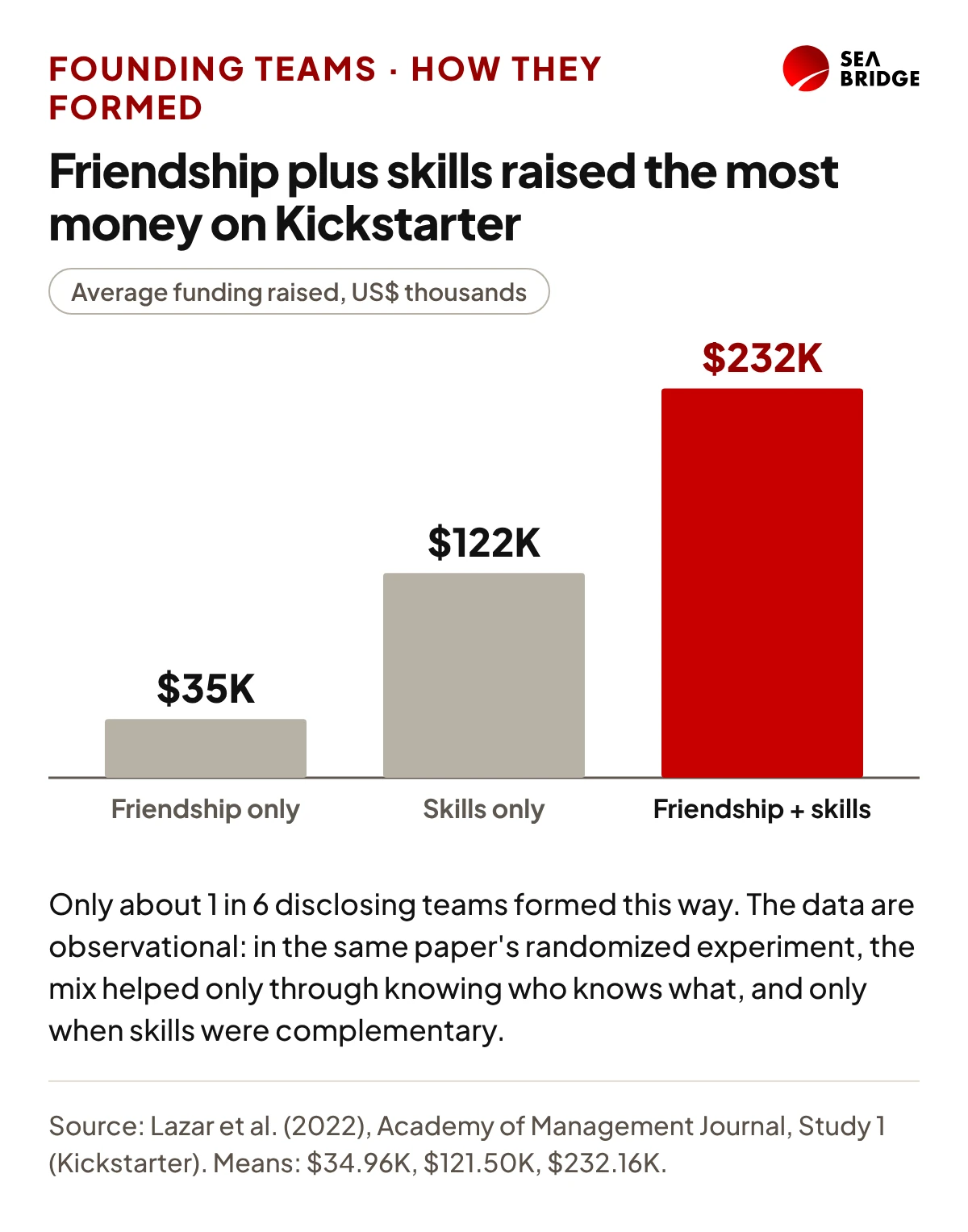
In a second sample, from an Israeli technology-entrepreneurship competition, about 10% of teams used both routes, and they were selected into the competition far more often2.
So the mix is rare. Across the two samples, only about 10–18% of teams formed this way.
That alone tells you something. If the best-performing route is also the least common one, most founders are not choosing it on purpose.
Does mixing friendship and skills cause better results?
Not directly. And this is the part most summaries leave out.
The first two studies are observational. Teams chose their own route, so other things could explain the gap in funding. The dollar figures in the chart are a pattern, not a measured effect of friendship plus skills.
The third study is the real test. It was a pre-registered, randomized field experiment with 94 student teams. The researchers set up teams with or without prior closeness, and with or without complementary skills2.
The combination had no direct effect on profit.
What it did change was the team's transactive memory: a shared sense of who knows what. That shared map was the route by which the mix reached profit. And even that indirect benefit only appeared when skills were genuinely complementary2.
Put plainly:
- Familiarity without complementary skills brought no indirect benefit.
- Complementary skills plus familiarity built a stronger shared map of who knows what, and that map was linked to profit.
- Familiarity helped because it let specialists coordinate.
I find this more useful than the headline. It tells you what friendship is for in a founding team. It is not the asset. It is what makes the assets talk to each other.
One more honest note. The samples were in the US and Israel. I have not seen a published study that tests this in Thai or ASEAN founding teams. So treat it as strong evidence from elsewhere, not proof for our region.
Why does trust matter more when skills are different?
Because specialists cannot check each other's work. They have to rely on it.
De Jong, Dirks and Gillespie pooled 112 studies covering 7,763 teams. Trust inside the team was linked to team performance at ρ = .303.
The link was stronger where members' skills were highly specialized: ρ = .36, against .23 where they were less specialized4.
A caveat matters here. That comparison is across studies. It shows that trust was worth more in specialized teams in general. It does not test complementarity inside one team. So it supports the pattern rather than proving it.
Still, the direction is the same as Lazar's experiment. The more different your skills, the more trust is worth.
That is why I describe it as a gate and a dial. Complementary skills are the gate: without them, trust has little to multiply. Trust is the dial: it decides how much of that complementarity the team can actually use.
What kind of similarity should co-founders share?
Similar values. Not similar backgrounds.
Harrison, Price, Gavin and Florey followed 144 student project teams over four waves5. As teams worked together longer, surface (demographic) differences mattered less. Deep-level differences, in values and attitudes, mattered more.
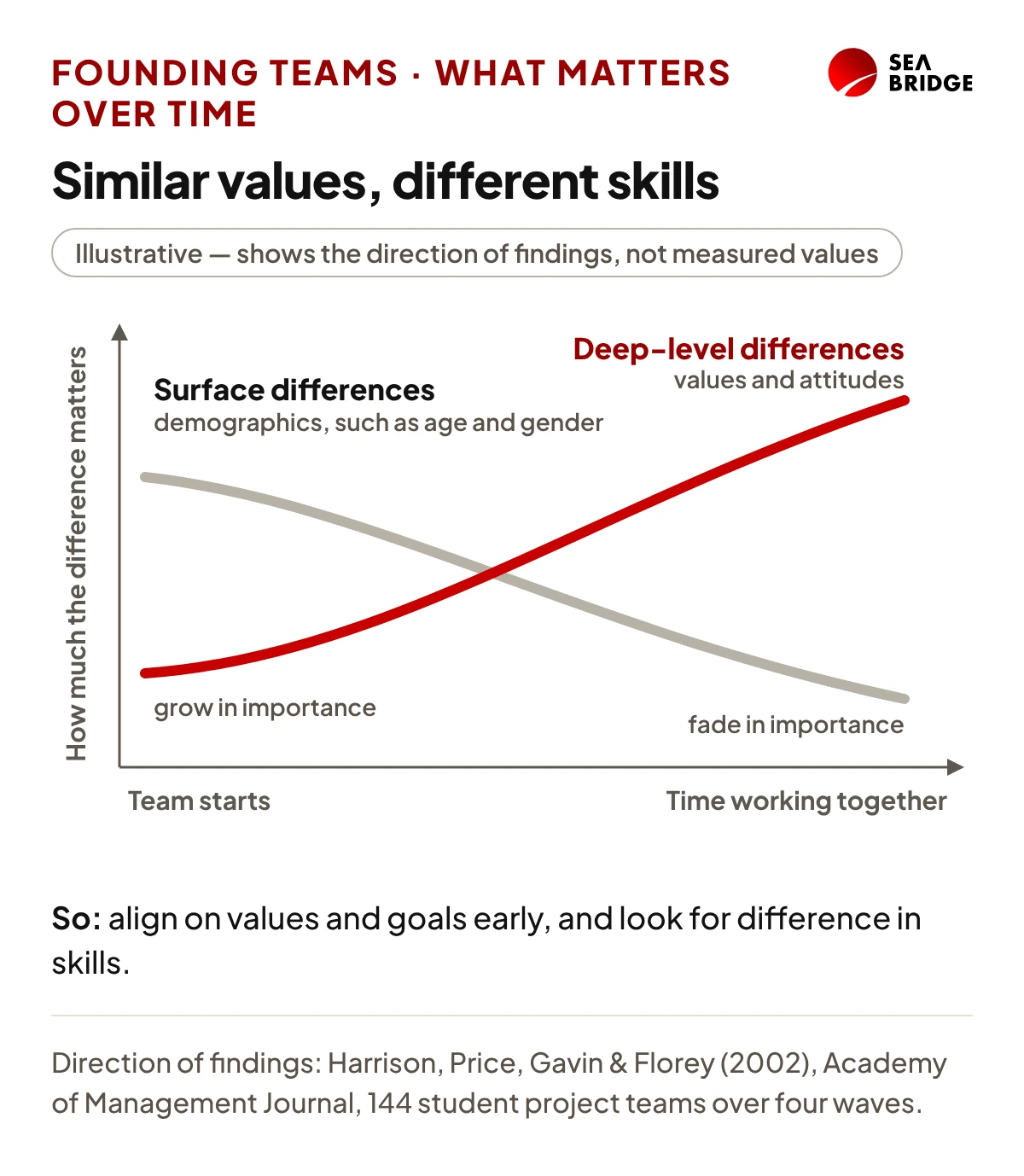
So the difference you notice on day one is rarely the one that breaks a team. The one that breaks it shows up later: how much risk each person will take, how many hours they will really give, what they want the company to become.
What about diversity in general? Van Dijk, van Engen and van Knippenberg reviewed 146 studies6. Job-related diversity, such as differences in function or expertise, related more positively to innovation than to in-role performance, and task complexity shaped the effect. Overall, though, the effects of diversity were small and depended on conditions.
Diversity alone is not a strategy. Diversity of skills, held together by shared values and trust, is.
Why do most founders end up with teams like themselves?
Because that is the path of least resistance.
Ruef, Aldrich and Carter studied 816 nascent entrepreneurs in the United States7. The strongest force in who founders teamed up with was homophily: people chose partners like themselves in gender, ethnicity and occupation. And the resulting teams were no more diverse in function than chance would produce.
In other words, founders mostly pick people like themselves. Complementarity happens by luck, if it happens at all.
This is the reason SEA Bridge built TeamFlow™ and uses the 4H Founder Archetypes. Not to tell you who to work with. To make complementarity visible before you commit.
- 4H shows what each person brings: the Hustler sells, the Hacker builds, the Hipster owns design, brand and experience, and the Hunter turns technology, industry knowledge or deep expertise into something that can be commercialized, through product and business development and go-to-market. It is the closer match to the skill complementarity Lazar and colleagues measured from résumés.
- TeamFlow shows how each person works in a team: Initiator, Aligner, Validator, Navigator. That is process complementarity, which this research did not test directly.
Used together, they turn "I think we cover everything" into a map the whole team can see.
What is the right mix of trust and diversity in a founding team?
There is no proven formula. I looked for evidence of an ideal diversity percentage or a perfect role balance, and did not find any.
What we use at SEA Bridge is a working rule, built from the studies above. It is our synthesis, not a tested law:
- Align values and goals first. Ambition, commitment, time, what success looks like. Deep-level differences grow over time5, so settle them early.
- Cover the roles. Make sure each needed skill (4H) and each team process (TeamFlow) has a named owner. Aim for coverage, not equal numbers.
- Build trust on purpose. If you are not already close, do something real together before you commit: a short trial project, then a written team charter.
- Avoid two-versus-two splits. Two friends from one school plus two strangers from another can split along every line at once. Faultline theory warns that aligned subgroups are riskier than diversity itself8. Mix ties across role owners.
- Keep task disagreement from turning personal. Relationship conflict is consistently harmful. Task conflict is close to neutral on average, and less harmful when it stays separate from personal friction9. Agree how you will disagree.
Two quick diagnoses follow from the rule:
- High trust, overlapping skills? Add the missing skill. Do not just add another friend.
- Complementary skills, low trust? Do not reshuffle. Invest in a trial sprint and a charter.
How should classes and programs form student teams?
This is where I have to be honest about my own classroom.
In Global Venture I, teams form in the first weeks, and they are mixed by design. That gives most teams a real spread of skills. What it cannot give them is trust. Most members meet as strangers, without shared values or goals yet.
That is not a flaw to hide. It is the condition the course is built around. It is why Global Venture I front-loads the self-knowledge tools and the five team agreements, and why we check the team's stage after every block. A mixed team of strangers can still become a strong team. It just has to build on purpose what friends bring by default.
In Global Venture II we build trust before teams lock in. This is how we are building team formation into the course:
- Mix before you match. Students first work across groups on short tasks, so they learn who they work well with before choosing.
- Form on three things. Shared goals, TeamFlow coverage and 4H coverage. Friendship is welcome; it is not the criterion.
- Trial sprint plus charter, with one re-form window. Teams run a short sprint, write a charter, then get one chance to re-form before they commit. In a study of 32 MBA teams, those that built high-quality charters and performance strategies early performed best over time10.
- Midpoint re-check. Teams tend to revise how they work around the midpoint of a project11, so we re-run TeamFlow there, with a short trust and psychological-safety check, and look at whether disagreement is staying about the work.
None of this guarantees a great team. It raises the odds that complementarity and trust arrive together, instead of hoping one shows up later.
What should you do this week?
- Take the free TeamFlow assessment at teamflow.seabridge.space. It takes about ten minutes and needs no account; your report arrives by email.
- Map your team on 4H. Mark each H strong, thin or missing. Read Taking the TeamFlow Assessment for how to use the two together.
- Name one value question your team has not discussed yet, and put it on the next meeting agenda.
Frequently asked questions
Is it a good idea to start a company with friends?
Only if your skills are different. In the Kickstarter study, friendship-only teams raised the least; friendship plus complementary skills did best. Friendship helps because it lets specialists coordinate, not because it replaces skills.
What is a dual formation strategy?
Forming a founding team on both interpersonal attraction (people you are close to) and resource seeking (people with complementary skills). Lazar et al. (2022) found only about 10–18% of teams formed this way across two field samples.
Does friendship plus skills cause startup success?
Not directly. In a pre-registered randomized experiment with 94 teams, the combination had no direct effect on profit. It worked through transactive memory, knowing who knows what, and only when skills were complementary.
What is transactive memory in a team?
A shared map of who knows what. It lets members rely on each other's expertise instead of duplicating it.
What kind of diversity matters in a founding team?
Differences in skills and expertise relate more positively to innovation than to routine performance, though the effects are small and depend on conditions. Differences in values grow more harmful over time, so align on those early.
Is there an ideal amount of diversity in a team?
No evidence supports an ideal percentage. What is supported is covering the needed skills and roles, building trust, and avoiding teams that split into two similar pairs.
Why do founders pick people like themselves?
Homophily. In a US study of 816 nascent entrepreneurs, founders chose partners similar in gender, ethnicity and occupation, and teams were no more functionally diverse than chance.
Keep reading
- The 4H Founder Archetypes: what each person brings
- TeamFlow™: Your Best Role in the Innovation Team: how each person works
- Taking the TeamFlow Assessment: using TeamFlow and 4H together
- Team Formation Science: why every new team feels chaotic at first
References
- Lazar, M., Miron-Spektor, E., Chen, G., Goldfarb, B., Erez, M., & Agarwal, R. (2022). Forming entrepreneurial teams: Mixing business and friendship to create transactive memory systems for enhanced success. Academy of Management Journal, 65(4), 1110–1138. https://doi.org/10.5465/amj.2020.0393
- Lazar, M., et al. (2022). Author manuscript of reference 1 (study-by-study figures). NSF Public Access Repository. https://par.nsf.gov/servlets/purl/10272194 — accessed Nov 2026.
- De Jong, B. A., Dirks, K. T., & Gillespie, N. (2016). Trust and team performance: A meta-analysis of main effects, moderators, and covariates. Journal of Applied Psychology, 101(8), 1134–1150. https://doi.org/10.1037/apl0000110
- De Jong, B. A., Dirks, K. T., & Gillespie, N. (2016). Author manuscript of reference 3 (moderator results). ACU Research Bank. https://acuresearchbank.acu.edu.au/items/79b04749-0f38-4375-96e6-00a33927e32f — accessed Nov 2026.
- Harrison, D. A., Price, K. H., Gavin, J. H., & Florey, A. T. (2002). Time, teams, and task performance: Changing effects of surface- and deep-level diversity on group functioning. Academy of Management Journal, 45(5), 1029–1045. https://doi.org/10.2307/3069328
- van Dijk, H., van Engen, M. L., & van Knippenberg, D. (2012). Defying conventional wisdom: A meta-analytical examination of the differences between demographic and job-related diversity relationships with performance. Organizational Behavior and Human Decision Processes, 119(1), 38–53. https://doi.org/10.1016/j.obhdp.2012.06.003
- Ruef, M., Aldrich, H. E., & Carter, N. M. (2003). The structure of founding teams: Homophily, strong ties, and isolation among U.S. entrepreneurs. American Sociological Review, 68(2), 195–222. https://doi.org/10.1177/000312240306800202
- Lau, D. C., & Murnighan, J. K. (1998). Demographic diversity and faultlines: The compositional dynamics of organizational groups. Academy of Management Review, 23(2), 325–340. https://doi.org/10.5465/amr.1998.533229
- de Wit, F. R. C., Greer, L. L., & Jehn, K. A. (2012). The paradox of intragroup conflict: A meta-analysis. Journal of Applied Psychology, 97(2), 360–390. https://doi.org/10.1037/a0024844
- Mathieu, J. E., & Rapp, T. L. (2009). Laying the foundation for successful team performance trajectories: The roles of team charters and performance strategies. Journal of Applied Psychology, 94(1), 90–103. https://doi.org/10.1037/a0013257
- Gersick, C. J. G. (1988). Time and transition in work teams: Toward a new model of group development. Academy of Management Journal, 31(1), 9–41. https://doi.org/10.5465/256496
About the author: Kasper-Tanakrit Sermsuksan is the Founder of SEA Bridge, a cross-border venture studio, and a Visiting Lecturer in Computer Engineering and Digital Technology at Chulalongkorn University's Faculty of Engineering. Learn more →