Read time: 7–8 min
The late Bill Joos spent a career teaching founders how to pitch. As a former Vice President of Sales at Apple, he had sat in more pitch meetings than most people have had important conversations. His most memorable piece of advice was not about storytelling structure or slide design.
It was this:
"Brief is hard. Long is lazy."
It sounds like a throwaway line. It is not. It is a diagnosis of almost every bad pitch ever delivered.
It is much easier to talk for fifteen minutes about your venture than to say the same thing in ninety seconds. Compression forces clarity. If you cannot say what your venture does and why it matters in two sentences, you have not yet understood it clearly enough yourself. That is not a presentation problem. It is a thinking problem — and the pitch is just where it becomes visible.
Most first-time founders approach pitching as a single event: one shot, one room, one outcome. That framing is almost always wrong.
A pitch is a sequence. The handshake intro earns the elevator conversation. The elevator conversation earns the napkin meeting. The napkin meeting earns the formal follow-up. The formal follow-up earns the deal. Each format has a specific desired outcome — and that outcome is always the next step, not the final step.
When you understand this, the anxiety around pitching changes. You are not trying to close everything in one go. You are trying to make someone curious enough to keep talking.
Bill Joos mapped the full pitch journey across eight formats, each with a specific length and a specific goal.

This is the answer you give when someone at an event, dinner, or chance encounter asks what you do. Not a paragraph. Not a summary. Seven to ten words that make the person say 'interesting, tell me more.'
The formula: what you do, for whom, with what distinctive result. 'We help Bangkok restaurants stop throwing money away.' 'We connect ASEAN students with global mentors.' 'We make vet care affordable for pet owners outside Bangkok.' Not perfect — but specific enough to open a conversation.
The handshake intro is harder to write than a two-page executive summary. Most founders cannot do it on the first try. The ones who can have done the hard thinking about what actually matters.
Named for the hypothetical shared elevator ride with someone who matters. You have thirty seconds to ninety seconds. The goal is to make them want to keep talking when the elevator opens.
Structure: start with the problem (makes the listener feel the pain), then the solution (specific and credible), then the evidence (real, not hypothetical), then the invitation to continue the conversation. No jargon. No caveats. No history of how you arrived at this idea.
The most common elevator pitch mistake: spending too long on the problem and running out of time before the solution. Practice with a timer. Thirty seconds is harder than ninety. Master thirty first.
The name comes from the idea of explaining your venture on a napkin — informal, conversational, but substantive. This is the extended conversation with someone who has chosen to spend real time with you.
You go through your market, your solution, your model, your traction, your team, and your ask in enough depth that the listener can form a real opinion. Unlike a formal investor pitch, the napkin pitch is conversational — you are reading the room and adjusting what you emphasize based on what they respond to. You are not delivering a script. You are having a structured conversation.
This is the format most relevant to your first serious stakeholder conversations: with mentors, potential partners, early customers, or angel investors who agreed to coffee.
For more formal investor pitches, Bill Joos mapped thirteen essential elements. This is not a rigid sequence — order can shift depending on the story you are telling — but these are the minimum building blocks of a credible investor pitch.
1 Title, Presenter Name, and Mantra — your 7–10 word handshake intro goes here
2 60-Second Overview — the entire story compressed into two minutes
3 Players (Market), Problem, and Pain — who has this problem and what does it cost them?
4 Painkiller (Solution) — what you do and why it works better than what exists
5 Your Secret Sauce — technology, IP, unfair advantage, or method that competitors cannot easily copy
6 Competition — honest competitive landscape; shows you know the market
7 Business Model — how you make money, from whom, at what margin
8 Go-to-Market Plans — how you reach your first 100, then 1,000, then 10,000 customers
9 Metrics and Money — the numbers you track and what they show
10 Team — who is building this and why you are the right people
11 Timeline and Status — where you are now, what milestones are ahead
12 Money Sought and Use of Proceeds — what you are asking for and exactly how it will be used
13 Why Invest in Us? — your closing argument, the 10% they will remember

The 10% rule: investors will remember approximately 10% of what you show them. Every slide earns its place or it is cut. If a slide exists to make you feel comprehensive rather than to change the listener's understanding, it should not be in the deck.
One more thing Bill Joos was consistent about: the deck is not a document. It is a visual aid to a conversation. If your deck can be understood without you in the room, it is probably doing the work a memo should be doing. The deck supports the story you are telling out loud. It does not replace it.
For any pitch longer than ninety seconds, Bill Joos used what he called the Bookend structure: open with your handshake intro, deliver your content, and close with your handshake intro again.
The repetition is intentional. People remember what they hear first and what they hear last. Bookending ensures the most important thing — your core proposition — is what they retain. Open with it. Close with it. Everything in the middle is evidence and support.
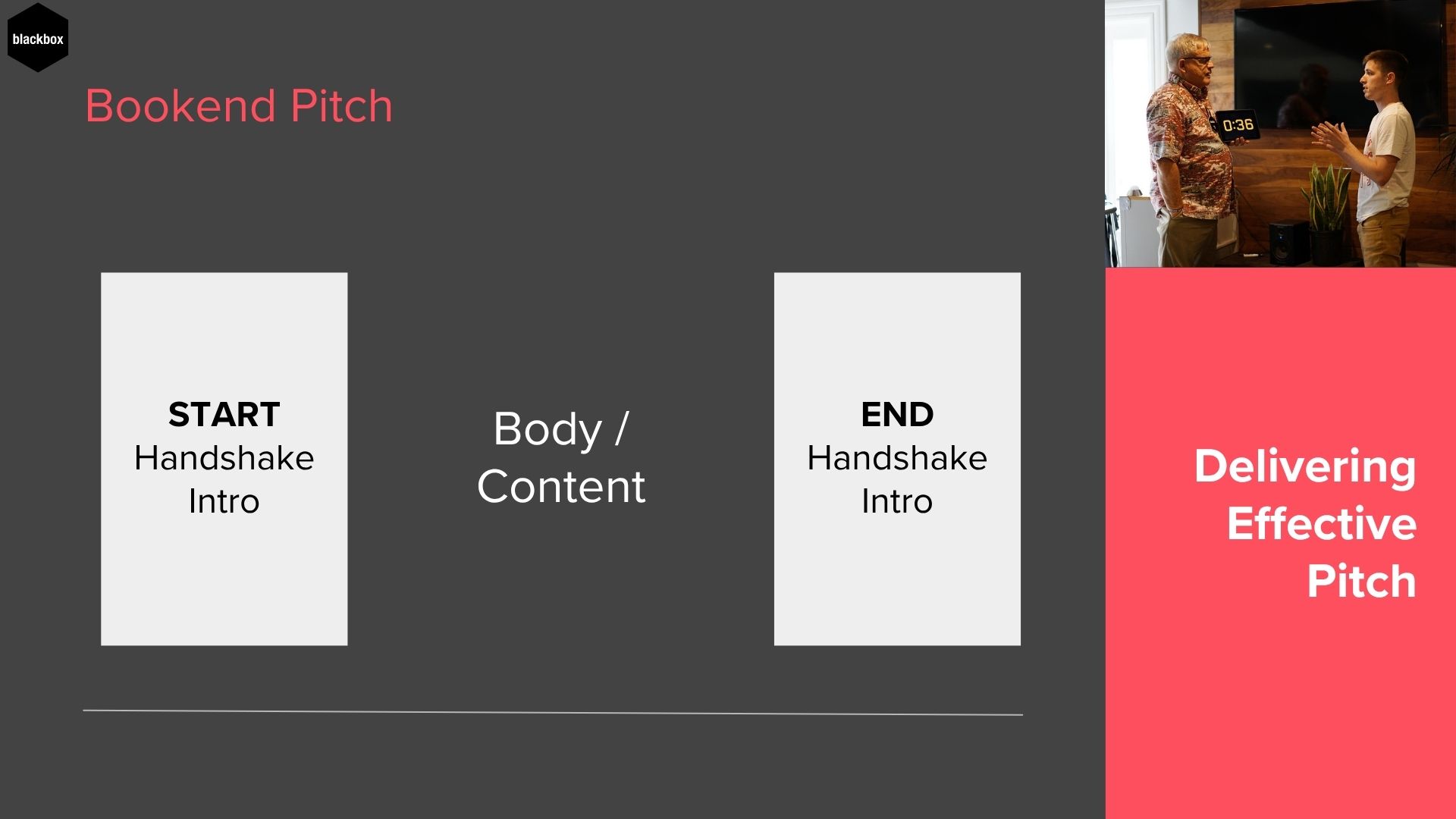
"Open strong. Build the case. Close with the same line you opened with. If they remember nothing else, they remember that."
Applied to your final presentation: open with your handshake intro, deliver your substantive content, and close by returning to that same line. The listener should leave with one clear sentence ringing in their head. That is the test.
All the structure in the world fails if the person in front of you does not believe you believe what you are saying. The most important ingredient in any pitch is not the slides, not the data, not the format. It is that you are genuinely excited about the problem you are solving and honest about what you do and do not know.
Practice, yes. Know your material cold, yes. But the goal of practice is to get to the point where the structure disappears and what remains is a real conversation about something you care about. That is when pitching stops being performance and starts working.
A Note for GVP Students
Your Block G assignment asks you to choose a pitch format — Sandwich, Handshake, or Napkin — and explain why you chose it for your venture and your audience at Final Presentation. That choice matters. A 5-minute showcase slot is not the same as a 30-minute investor meeting. The format shapes what you include, what you leave out, and how you open and close.
One specific exercise before Class 13: write your handshake intro. Seven to ten words. No qualifiers. No caveats. Say it out loud ten times. If it does not feel natural yet, that is your signal to keep working. Your venture concept, your 6-Page Memo, and your BMC are all inputs — the handshake intro is the output that proves you understood them.
Read next in this series: The Art of Pitching Less: Why Restraint Wins Meetings, The Amazon 6-Page Memo — Writing That Forces Clarity
Kasper-Tanakrit Sermsuksan is the Founder of SEA Bridge, Dean of SEA Bridge Institute of Entrepreneurship, and a Visiting Lecturer at Chulalongkorn University, Faculty of Engineering (Computer Engineering). Learn more →